
Tinkering encouraged!
In the training center, apprentices are encouraged to test their own solutions and learn from mistakes. Apprentices and dual students at STIHL receive more than first-class training; they also have the opportunity to get involved in special projects. Whether restoring a go-kart or welding a sculpture made of 500 individual parts, apprentices grow into innovators.
Marc Münzenmay carefully tightens one of the bolts connecting the yellow plastic seat to the red frame. In his first year of training, the industrial mechanic is working intently on the historic go-kart currently being restored at the STIHL training center. “Whenever I need a break from our routine tasks, I can tinker with the go-kart,” he explains. The kart belonged to Willy Schetter, who won the German Championship twice with STIHL go-karts – though not with this model.“There's definitely a sense of respect when you're working on such a rarity, so it requires a great deal of finesse,” says Marc Münzenmay. Concentration, precision, and dexterity are skills that the apprentice can practice on this particular project. But these are not the only skills he's acquiring.
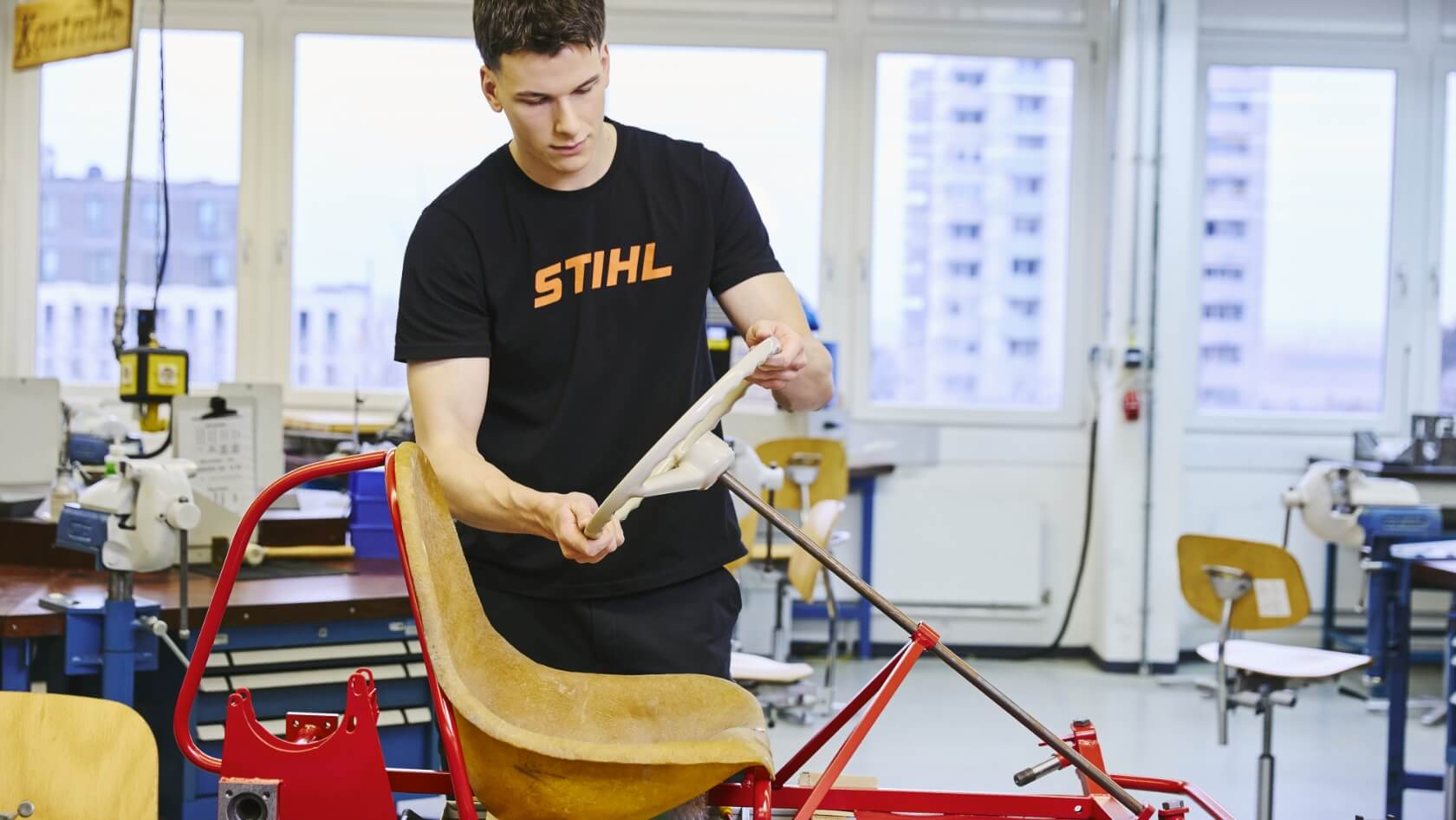
Marc Münzenmay reassembles the restored go-kart parts.
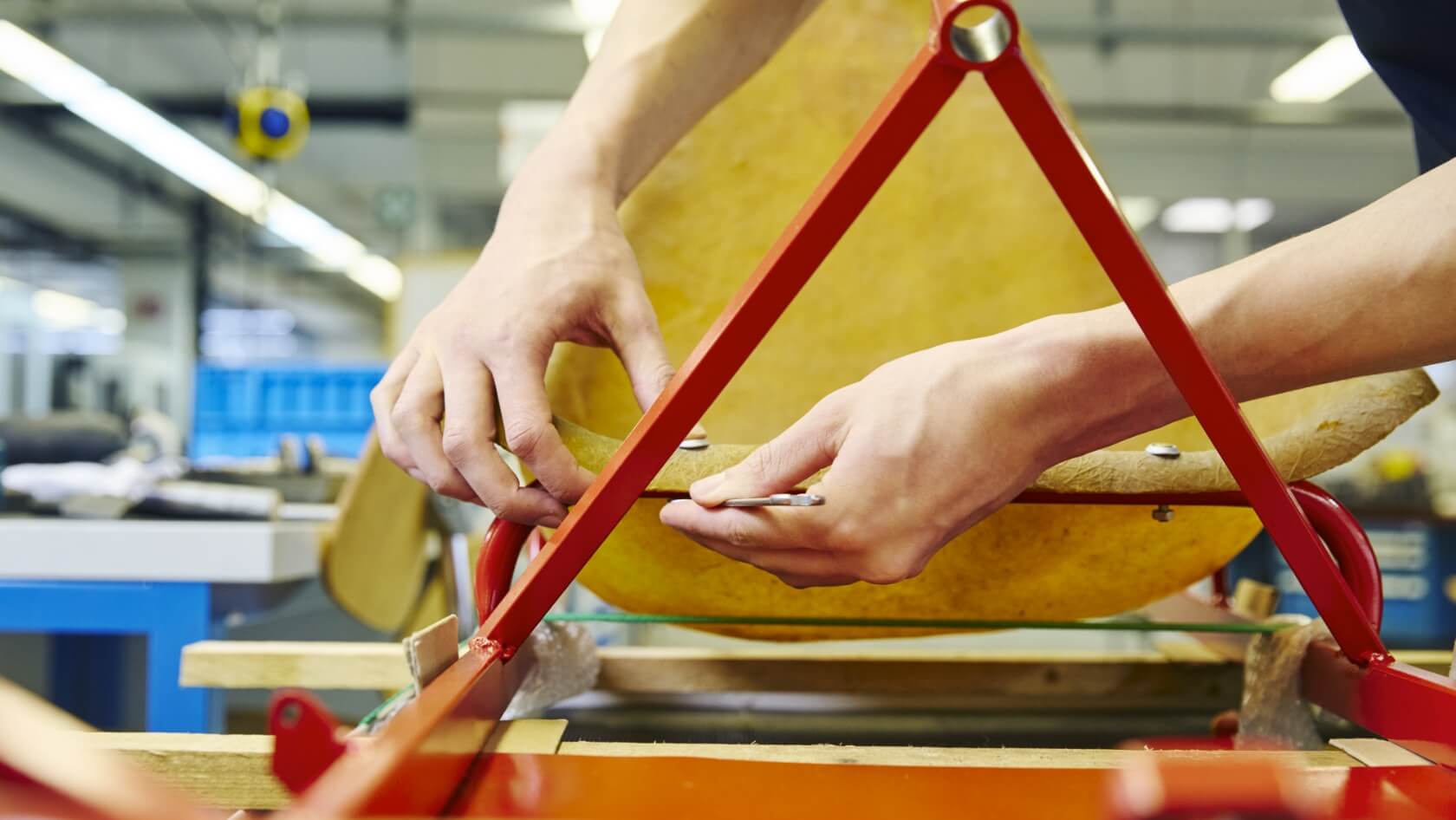
Restoration of the go-kart requires dexterity.
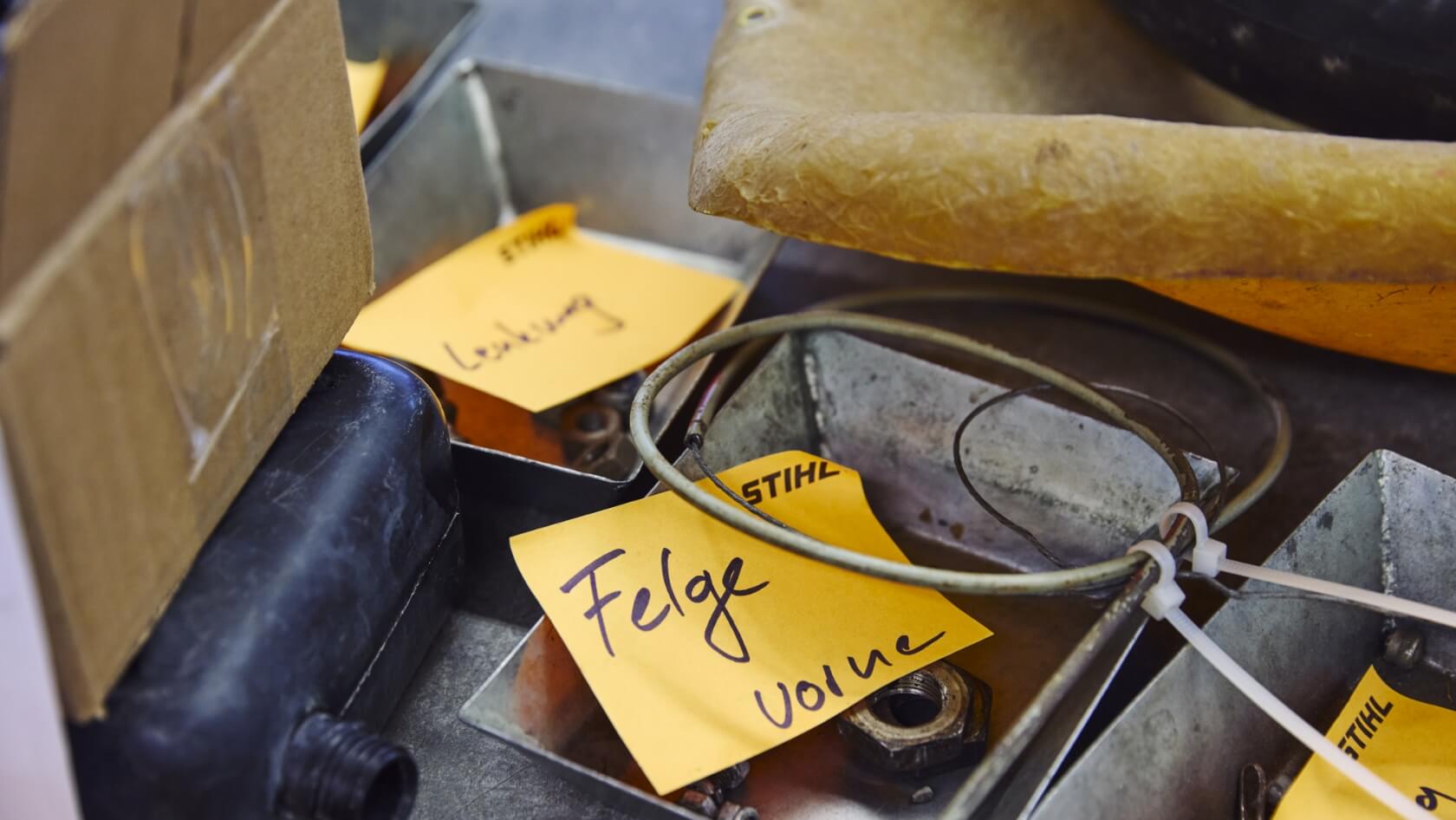
All individual go-kart components have been disassembled and thoroughly cleaned.
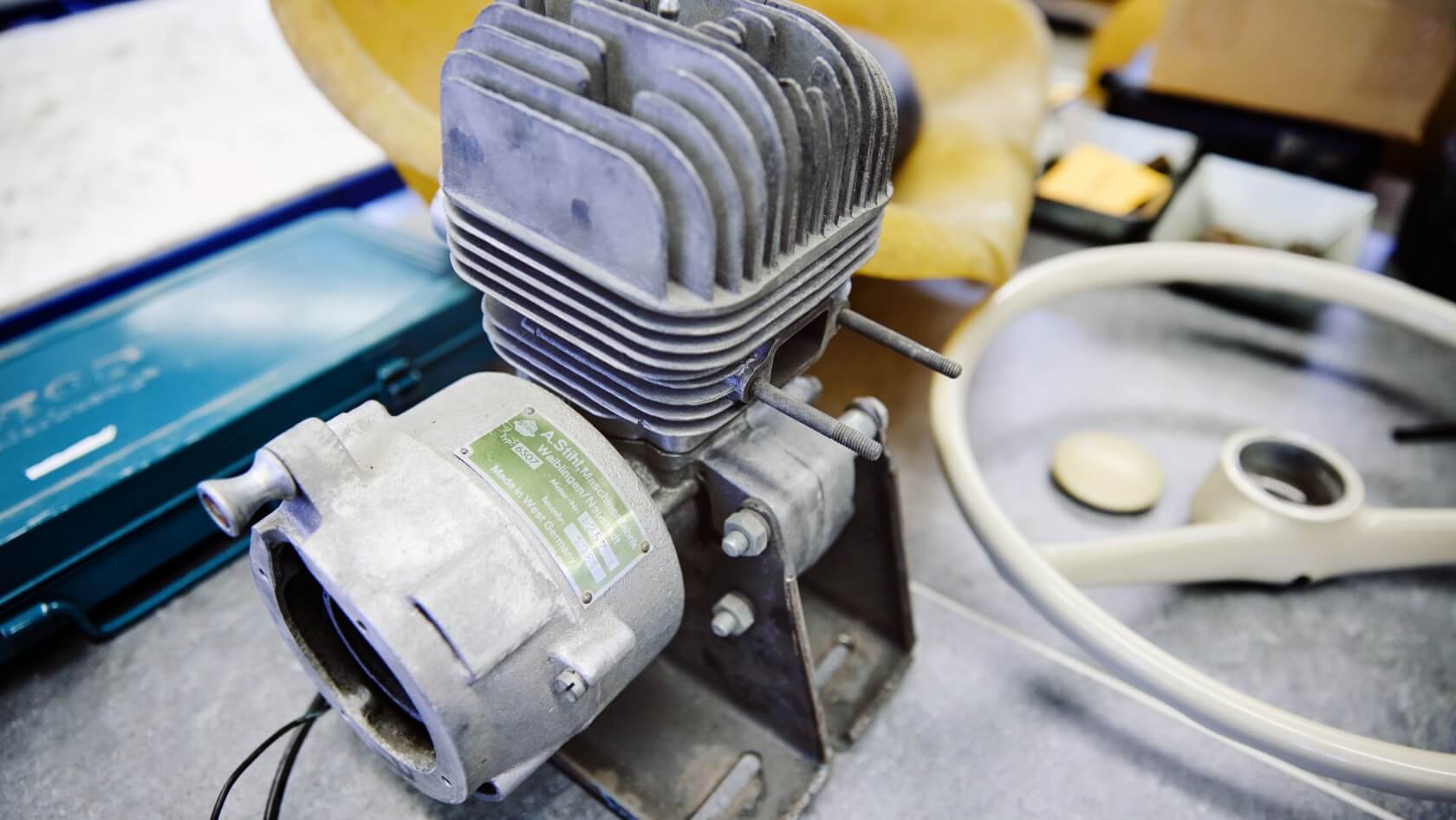
The heart of the go-kart: the engine – originally from a chainsaw.
Innovation, every day
Marc Münzenmay enjoys the independence of working on a go-kart. Also because he was challenged to develop creative solutions: “Some parts were extremely tight and, of course, we couldn't just use brute force to break them. We had to figure out how to separate the parts cleanly without breaking them.” In situations like these, the apprentice feels that he can be innovative even in his first year – finding new solutions to make things better.
Marc Münzenmay Industrial mechanic apprentice in his first year of training“We learn an incredible amount here in such a short time.”
Emma Wieland confirms this: “There are always situations where we can try something out. Even when a process is already defined, you often find your own way to make it better.” Emma is already in her third and final year of training as an industrial mechanic. For her, everyday innovation means thinking independently to discover better solutions, or using new technologies to make processes more efficient. “And that's encouraged in our training.”
Hands-on studies
STIHL offers more than just vocational training: Around half of the apprentices in Waiblingen are dual study students. The nine degree courses currently offered range from Mechanical Engineering and Computer Science to Digital Business Management. The students alternate between three months at the company and three months at the university. Practical work in the company is very important, as Training Manager Miriam Höfer explains: “An engineer needs to know how to operate a milling machine, for example, to be able to communicate with skilled workers and have an understanding of their work.” All dual study students at STIHL have the opportunity to spend a semester abroad for practical training. “The US is very popular for this, and the new battery plant in Romania and other STIHL companies around the world also offer great opportunities,” shares Miriam Höfer.
Every mistake is an opportunity
According to Training Manager Miriam Höfer, the basis for promoting innovation is a culture in which mistakes are seen as learning opportunities. “Mistakes have to happen so that we can reflect on them and learn from the experience.” To achieve this, apprentices acquire many skills on their own. Marc Münzenmay and the other apprentices are currently in the project phase of their basic training with the goal of a full functional marble run. Apprentices from all professional disciplines – from business professionals to all technical training professions – work together in teams, set up their own project management and personnel planning, calculate, produce, and present. Miriam Höfer knows from experience that students grow particularly quickly when working on such projects.
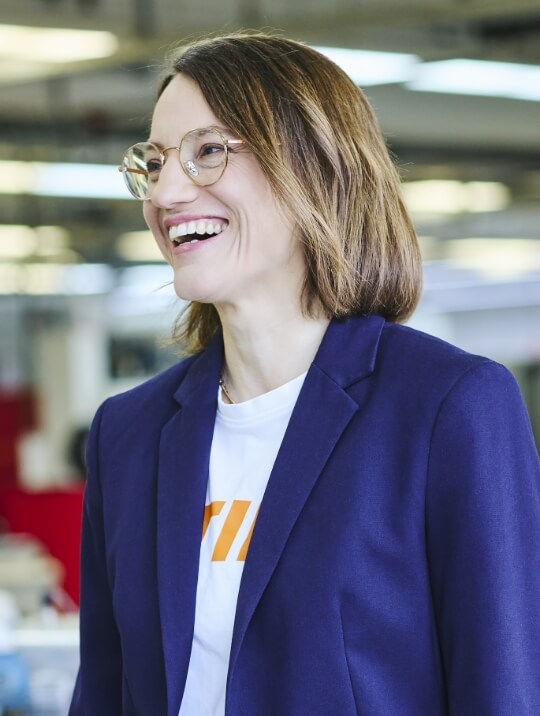
Miriam Höfer Training Manager at STIHL in Waiblingen“We want to give our apprentices and dual study students everything they need to reach their full potential.”
Growth is a priority for the training manager. “The primary focus is on professional qualification. But we also offer our students so much more, so that in the end we can say: We have trained them well.” This also includes the development of personal and social skills. An integral part of the training involves community service projects, such as supporting the Waiblingen Food Bank. There are also collaborations with the fire department, AI workshops, practical semesters abroad, and health modules where students learn skills such as stress management. This diverse range of opportunities is designed to equip our students with essential future skills such as independence, personal responsibility, and openness to new ideas.
Additional qualifications promote creativity
“The world of work is changing very fast these days. The more well-rounded young professionals are, the more flexibly they can adapt to changes,” believes Miriam Höfer. This is why STIHL also offers additional qualifications. Emma Wieland obtained one of these in additive manufacturing. The parts that she produces on the 3D printer are used for device prototypes, among other things. “I can be really creative with it because the printer produces exactly what I envision – and that can be a completely new part that performs a very specific task.”
Creativity was also required for a real work of art that Emma Wieland created at the end of her first year of training: a larger-than-life saw made from an estimated 500 small metal parts. “I thought to myself, I could repurpose the material instead of throwing away these old test parts,” she says. Welded together piece by piece, the parts formed a chainsaw model weighing over 375 pounds. The components including the handle, fuel cap, ventilation grille, guide bar, and chain are nearly identical to the original in proportions and look. The eye-catcher stands in a prominent position at the entrance to the training center. “I'm always happy when someone asks me about it,” says Emma Wieland.
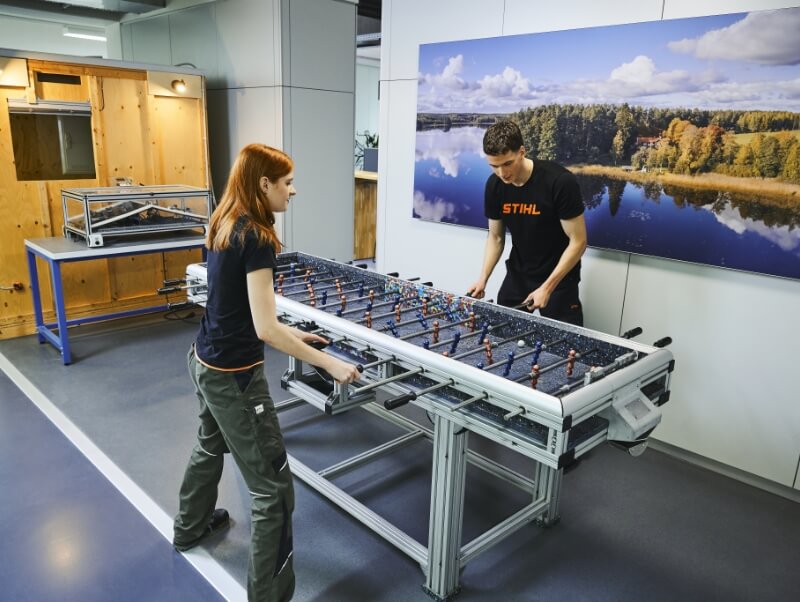
Even during breaks, skills can be developed – for example at the foosball table built by the apprentices themselves.
Emma Wieland Third-year industrial mechanic apprentice“I am quite proud of what I have built myself.”
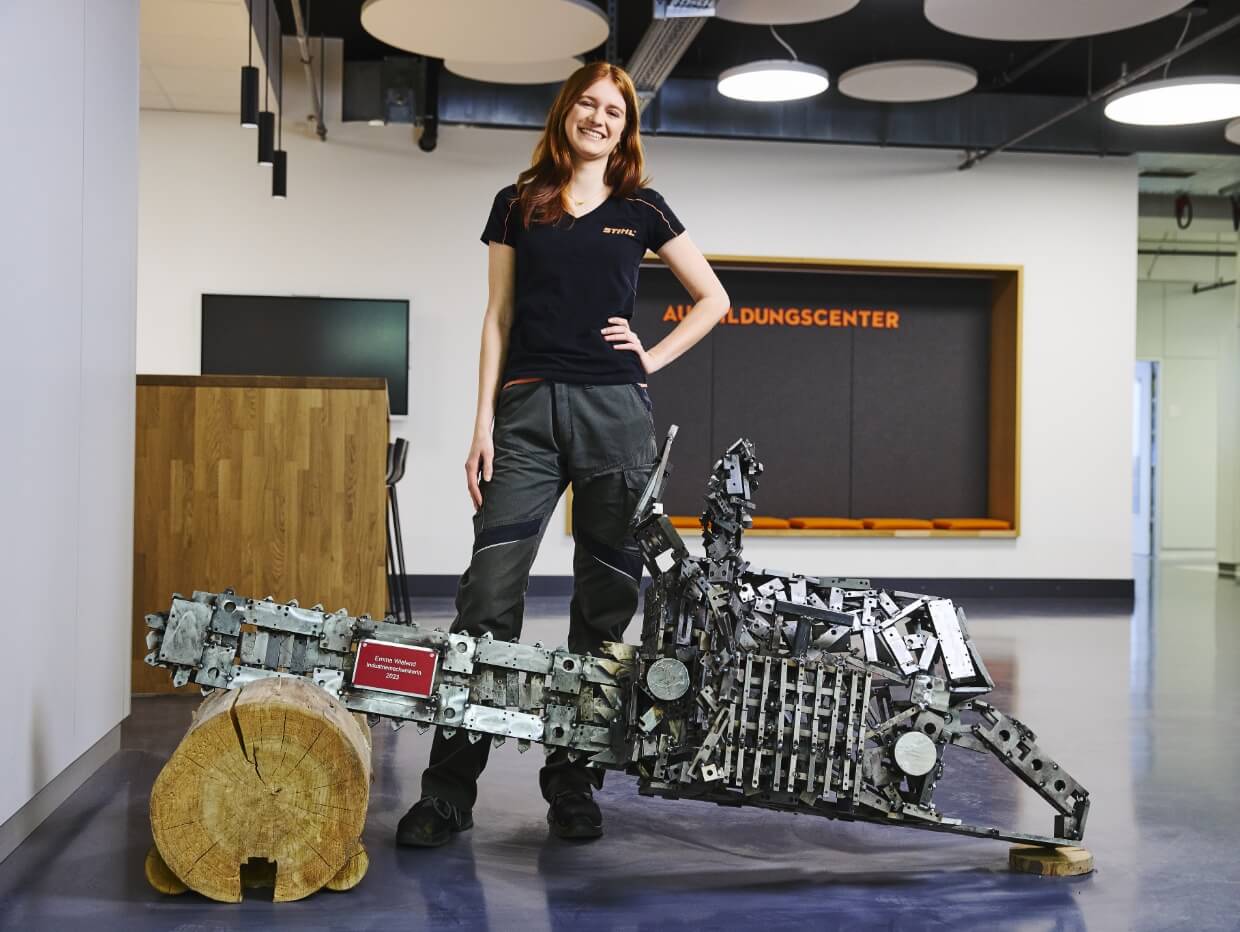
Emma Wieland with her masterpiece, a chainsaw model weighing over 375 pounds.
In her third year, Emma Wieland now works in a specialized department rather than the training center where basic training takes place. During their apprenticeship or dual study program, students rotate through different specialized departments, spending approximately three months in each area. Emma Wieland’s favorite department is special-purpose machinery, where production machines are manufactured for STIHL plants worldwide. Ideally, she would like to work in this department after her training. “But I also enjoy toolmaking and product development, which is why I’m not so picky,” she says and laughs.
70 percent stay with the company
STIHL currently offers seven apprenticeships and nine dual study programs in Waiblingen. Apprentices are also trained at the other locations in Germany. Around 70 percent of them start their careers at STIHL after completing their apprenticeship or dual study program; the rest pursue further education – for example with a bachelor’s degree following their apprenticeship or a master’s degree after completing their dual studies – or embark on different career paths. More information on the full range of career opportunities is available on the international STIHL career website.
Interaction as equals
Those like Emma Wieland who are nearing graduation have the tools they need to become true innovators. Marc Münzenmay also appreciates that practical training at STIHL encourages students to try new things and implement their own ideas. From his perspective, the human element is also essential for this: “The instructors are always there for us and treat us as equals.”
apprentices and dual students STIHL trains per year at its headquarters.
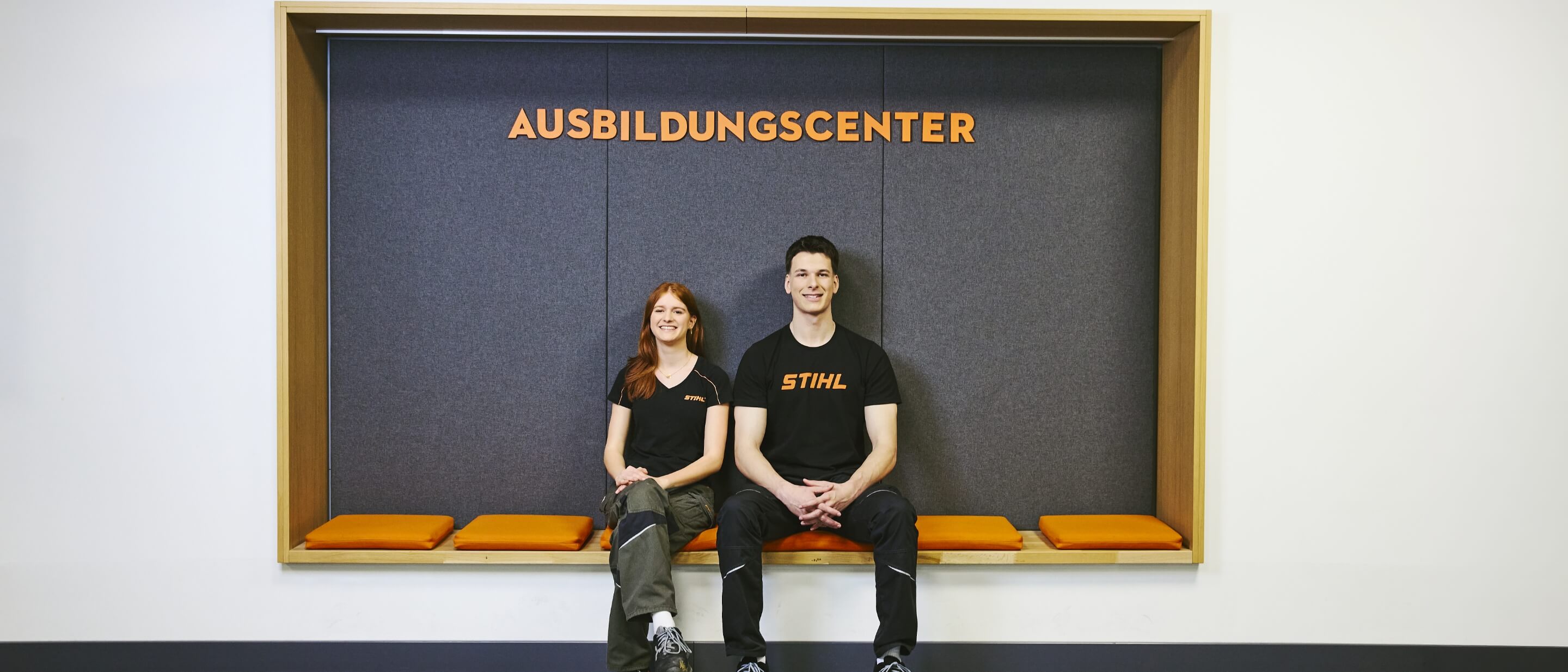
Emma Wieland and Marc Münzenmay also appreciate the human element of their training.