
A big push to reach the global market
The newest development from the Andreas Stihl machine factory heralds a revolution in forestry: A portable gasoline-powered chainsaw which can be used for felling trees. Attendees at the Leipzig Spring Fair 1930 are set to be amazed. Except for the fact that the few tools already manufactured are out of stock – there are no models to exhibit. How will customers be persuaded to buy the tool without a demonstration?
“They were grabbing the machines out of our hands,” Andreas Stihl later recalls about the year 1929. Business is thriving for the Andreas Stihl machine factory, especially in the year of the global economic crisis. It is not only the electric saws that STIHL has been selling since 1927 which are very popular; the new development from STIHL is the first-ever portable two-man gasoline-driven chainsaw, and it has also been well received by customers in the local region. Andreas Stihl wants to introduce it to a wider audience at the Leipzig Spring Fair in 1930 – just as he had done previously with his first electric saw. That trade fair appearance had resulted in many more chainsaws being ordered.
As such, the latest STIHL development absolutely has to make an appearance in Leipzig. Although there is a problem with that: As only a small number of gasoline chainsaws have been manufactured so far, they are all in the hands of appreciative buyers in the region's sawmills and veneer factories. With only a short time before the trade fair opens, there is not one single unit available to be exhibited. A trade fair appearance without a demo model? Unthinkable.
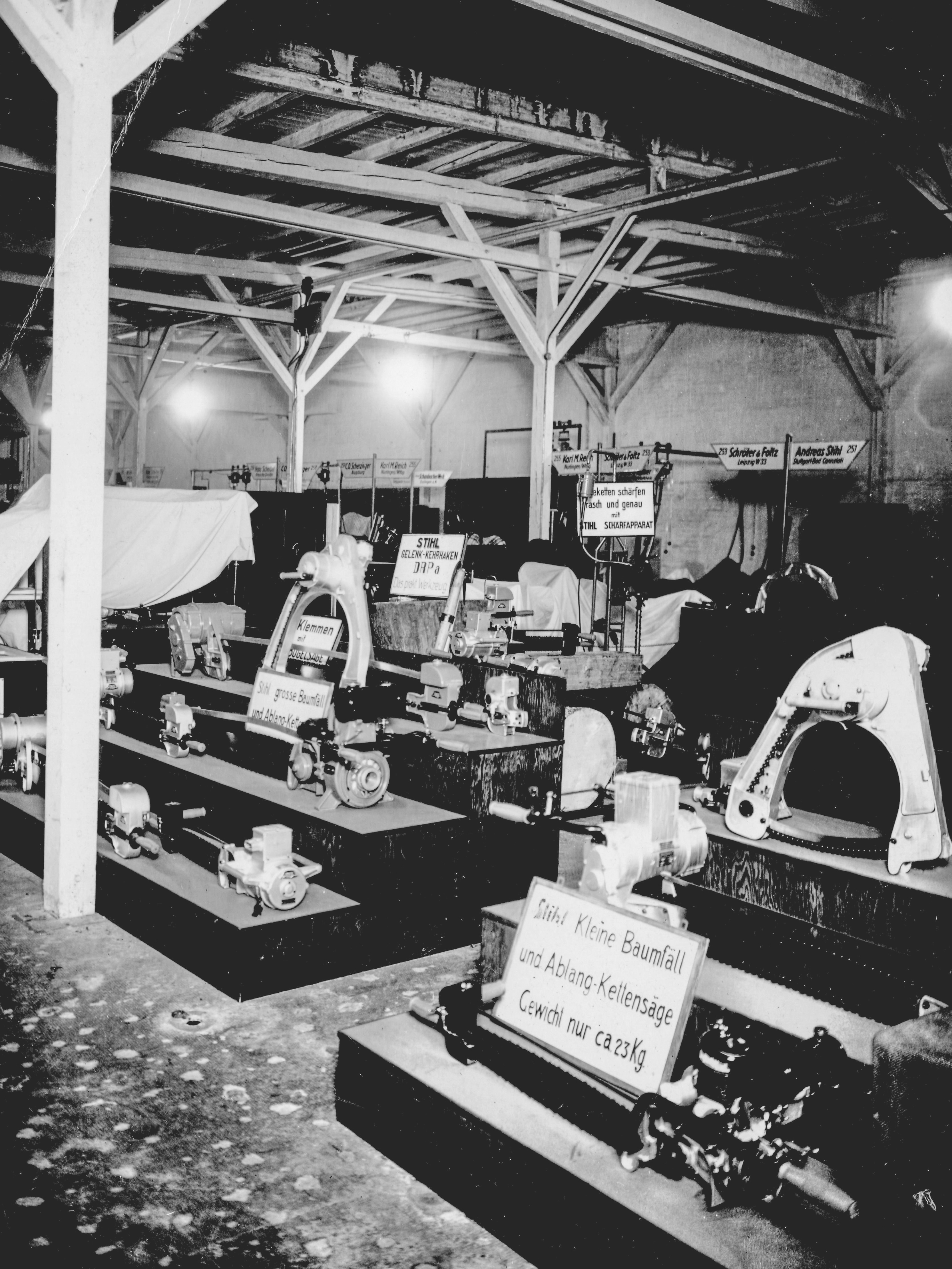
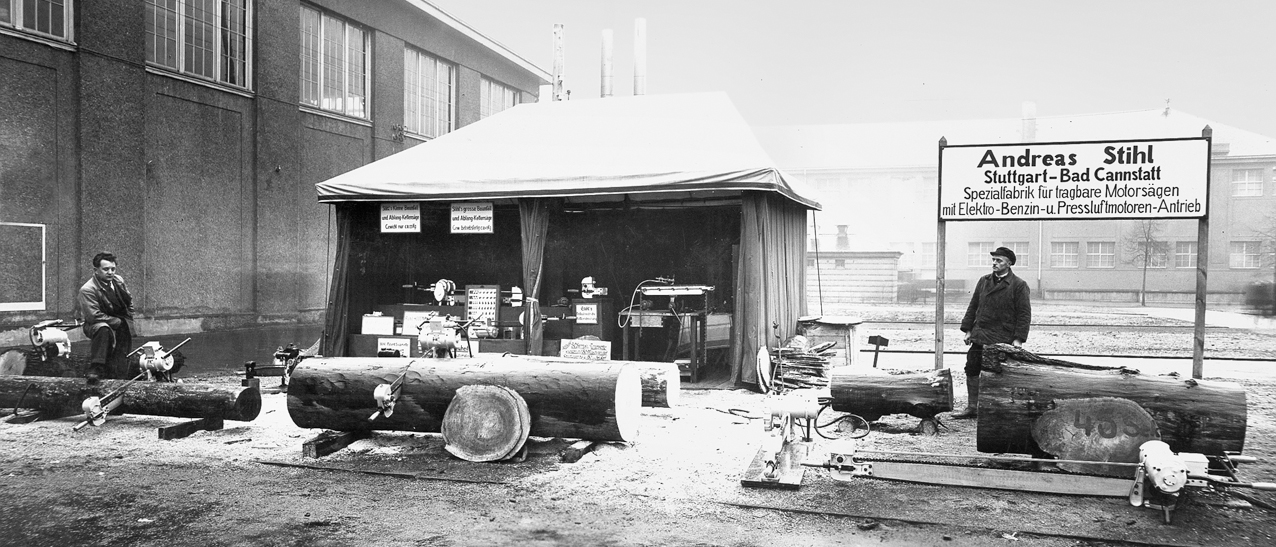
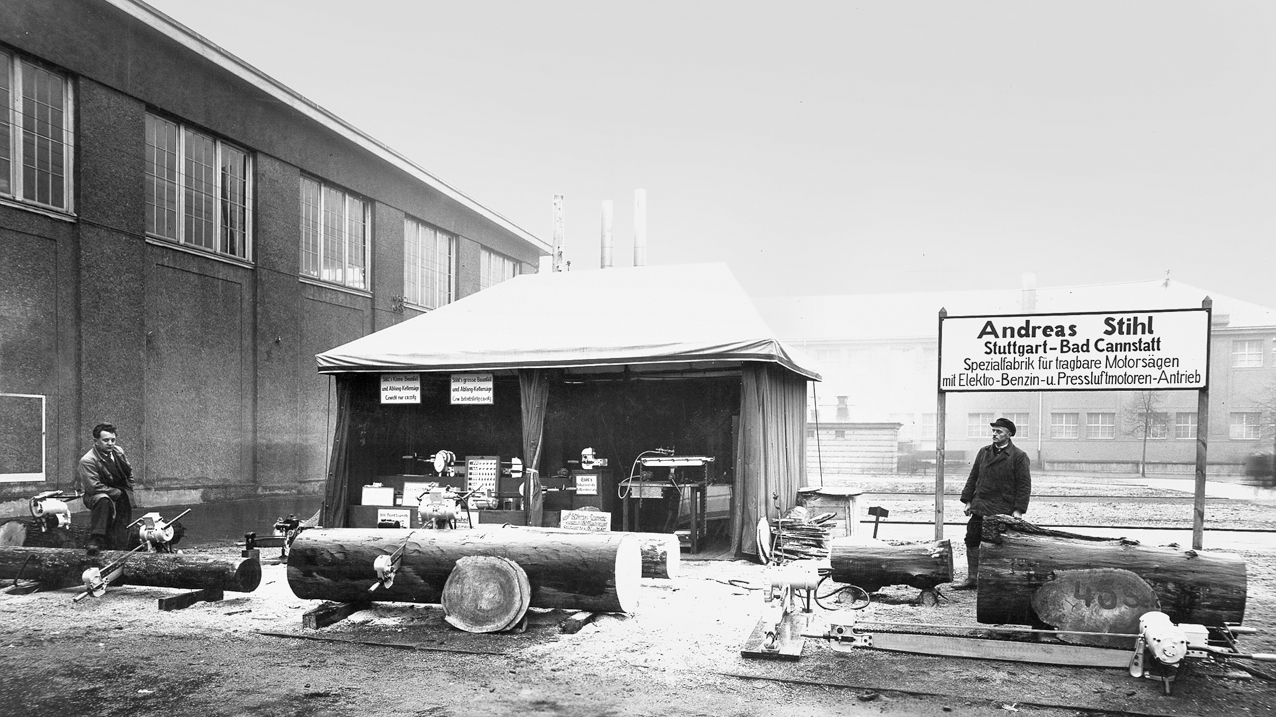
STIHL is a regular participant at the Leipzig trade fair – pictured here in 1936 and 1937.
On the last express train to Leipzig
Andreas Stihl is determined to showcase the gasoline chainsaw in Leipzig – and so he tasks the employees with a challenge: They work through the nights to quickly produce multiple examples of the 46 kg, 6 hp machines. This high-pressure working continues until 15 hours before the trade fair begins. The effort succeeded: The chainsaws arrive in Leipzig just in time, on the last express train from Stuttgart the evening before the trade fair.
All the effort pays off: The gasoline chainsaw generates huge interest in Leipzig. It will soon not only be delivered to customers in Germany, but also exported to France, Belgium, the Netherlands and Switzerland. Andreas Stihl expands the company in 1930 to meet the high demand; now employing 30 people, the company moves to the Cannstatt district of Stuttgart.
Globally important trade fair
The Leipzig Trade Fair is a globally significant event in the second half of the 1920s, encompassing 17 exhibition halls. Right up until 1991 the venue hosts “universal trade fairs” twice a year – in spring and autumn – at which companies from diverse industries showcase and demonstrate their products. STIHL later moves towards specialized trade fairs. Both universal and specialized trade fairs function as sample exhibitions, with only product samples being showcased rather than the entire range of merchandise. The world’s first sample trade fair took place in Leipzig in 1895.
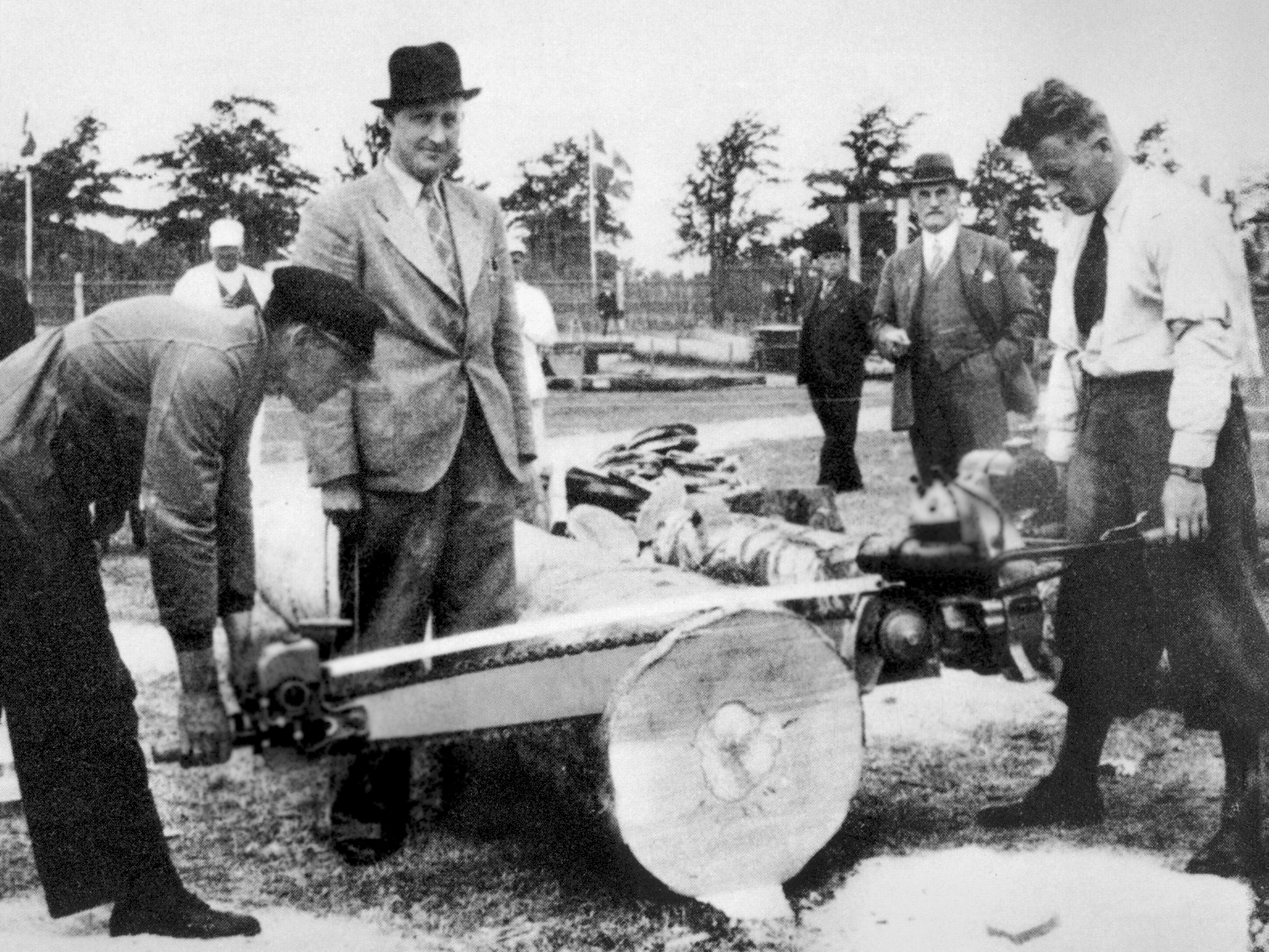
Demonstration of a two-man gasoline chainsaw at a trade fair in Stockholm 1936.
kilograms is the weight of the first gasoline-driven chainsaw from STIHL. It needs two people to carry it.
We must take the saw to the tree
The portable gasoline chainsaw succeeds due to its usefulness in forestry: It excels at horizontal cuts. Two people are required to carry its considerable weight, and it is initially used mostly in sawmills. While the first electric chainsaw can only be used for lengthwise cutting of already-felled trees, the gasoline chainsaw can also be used for felling trees. It is designated a “Type A tree felling machine”. This technology represents the crucial step of moving the saw to the tree, and changes forestry for good.
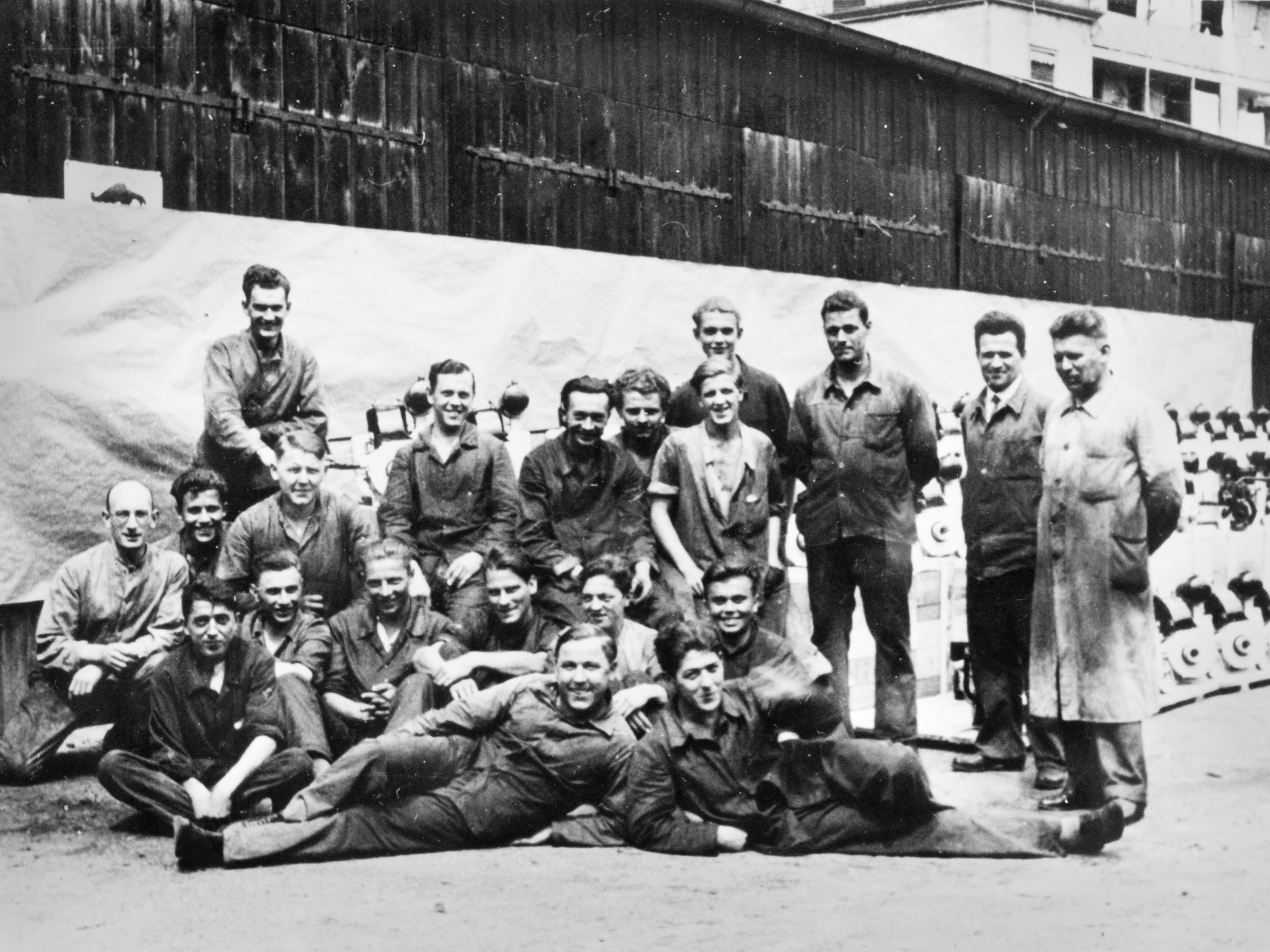
STIHL employees in 1931 proudly showing off a shipment of 300 gasoline chainsaws to Russia.
Trade fairs bring people together
Exhibiting at trade fairs is key to attracting new customers from all over the world. Nowhere else can a company demonstrate its own tools to so many people in such a short time. So of course STIHL always endeavors to have a presence at trade fairs. Specialist trade fairs continue to be an important mean, especially for connecting with representatives from specialized retail sectors and establishing contacts.
High demand for its tools means that the Andreas Stihl machine factory is initially able to avoid the impact of the economic crisis, though it is starting to bite by the end of 1930. As demand in Germany wanes, the company pursues new markets abroad – in Russia, Italy, and especially in the USA and Canada. Exporting is one of the early-established foundational pillars that ensures the long-term success of STIHL as a business. The portable gasoline chainsaw becomes an export blockbuster and eventually turns out to be the cornerstone of the company’s international success.