
Lifesavers
To save lives you need the right equipment: A tool that can successfully clear a path and provide access at the crucial moment. Since 2000, the STIHL rescue chainsaw has been supporting the work of the fire service and the Federal Agency for Technical Relief (Technisches Hilfswerk, THW) throughout Germany. Michael Fuchs, volunteer firefighter in Waiblingen and employee of STIHL, gives us an insight into a volunteer job that is technically demanding, to say the least.
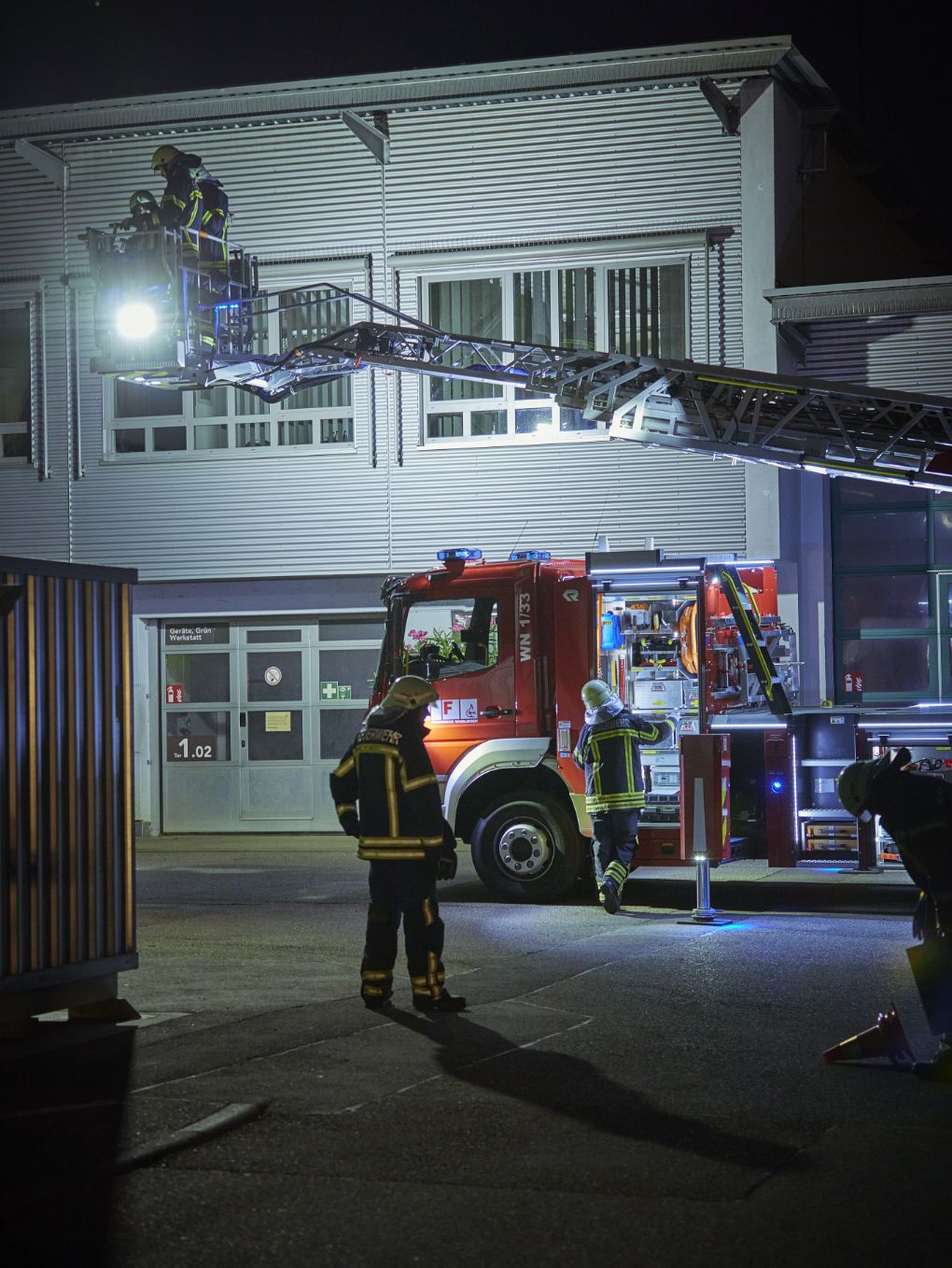
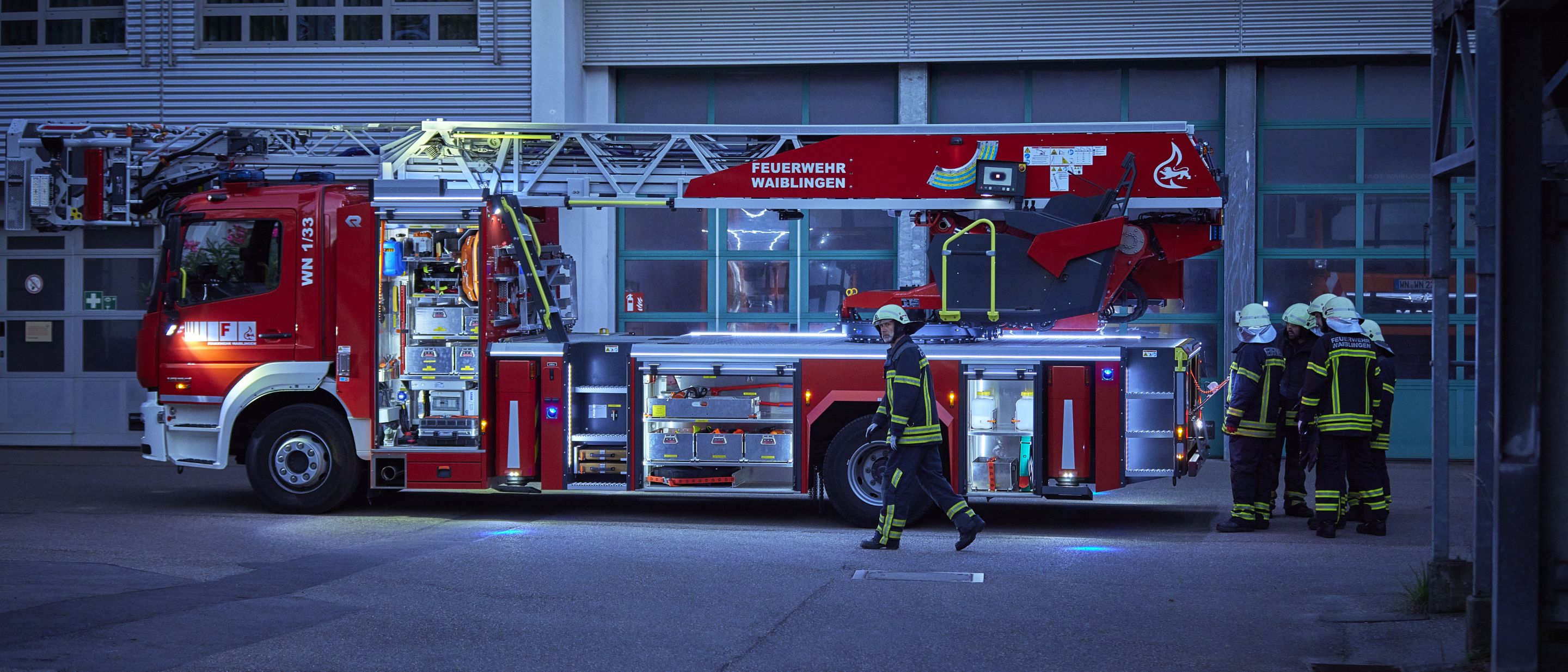
“This is our new turntable ladder, which is now also used in group services,” says Michael Fuchs proudly, pointing to a brightly lit emergency vehicle. On the rescue vehicle, which serves as the mobile toolbox for the Waiblingen Volunteer Fire Service (Freiwillige Feuerwehr, FF), the ladder and the fully loaded basket are slowly extending upwards. What’s special about this kit is that the basket and ladder come with a reclining attachment that allows people to be rescued from higher floors via balconies or windows – rather than being recovered from within a building. “Only bodies and objects should be described as recovered; living people and animals are always rescued. This is something the news often gets wrong,” Michael Fuchs is eager to explain.
Technical relief services
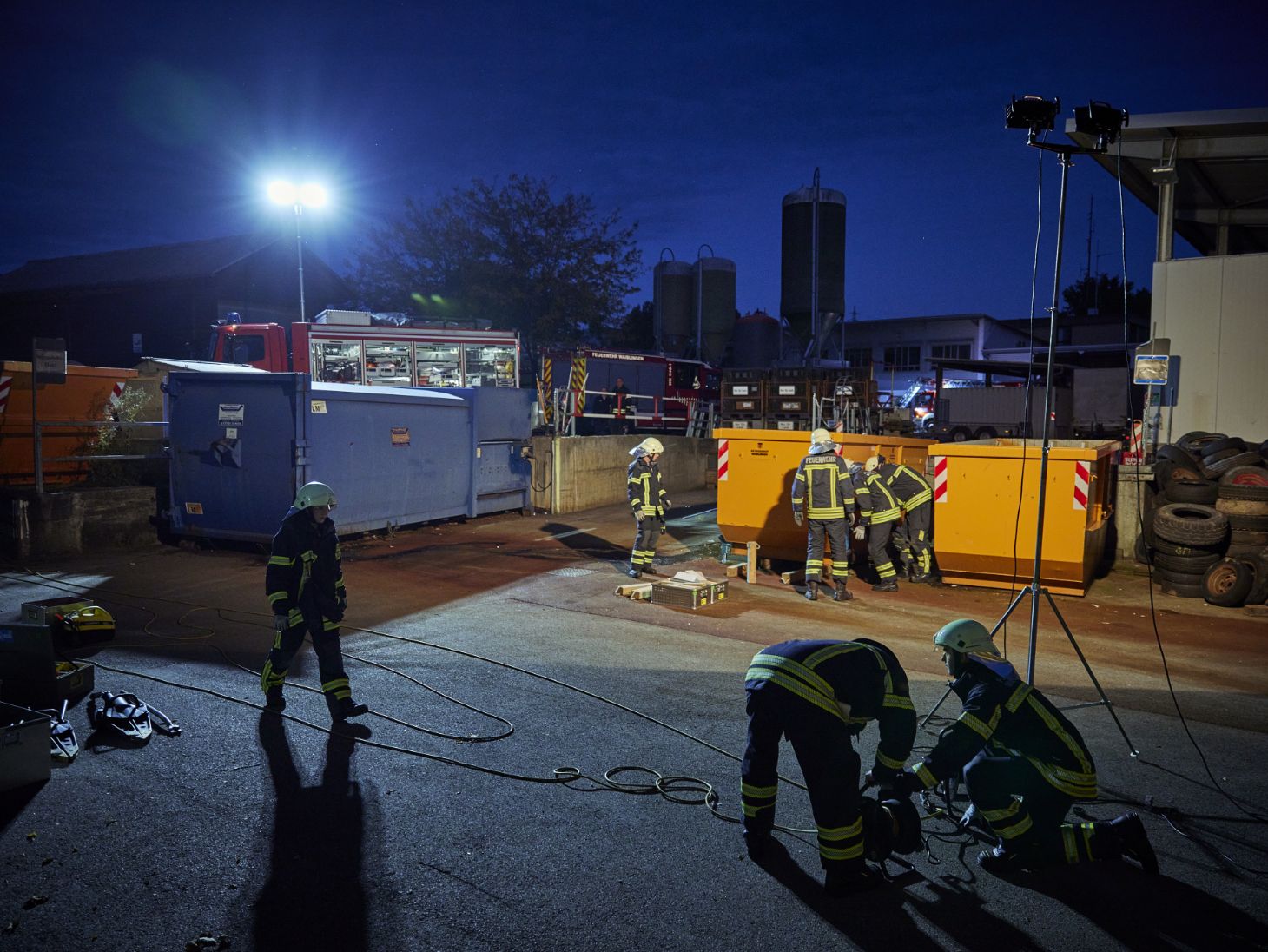
This Wednesday evening the turntable ladder will be involved in a comprehensive program of exercises taking place on a building site in Waiblingen. “What we call the technical relief service essentially relates to all the stuff that has nothing to do with firefighting,” explains Michael Fuchs. Today, the approximately 25 men and women of the Waiblingen department are practicing lifting a container that weighs several tons using a hydraulic winch and lifting cushions, as well as how they would theoretically use a hydraulic spreader to rescue individuals trapped in a vehicle. Even though these exercises are only drills, Michael Fuchs confirms that they can still teach a great deal that is of use for real emergencies. The members of the Waiblingen fire service participate in training sessions like this one to learn how to use a variety of tools and equipment. A practice that saves lives.
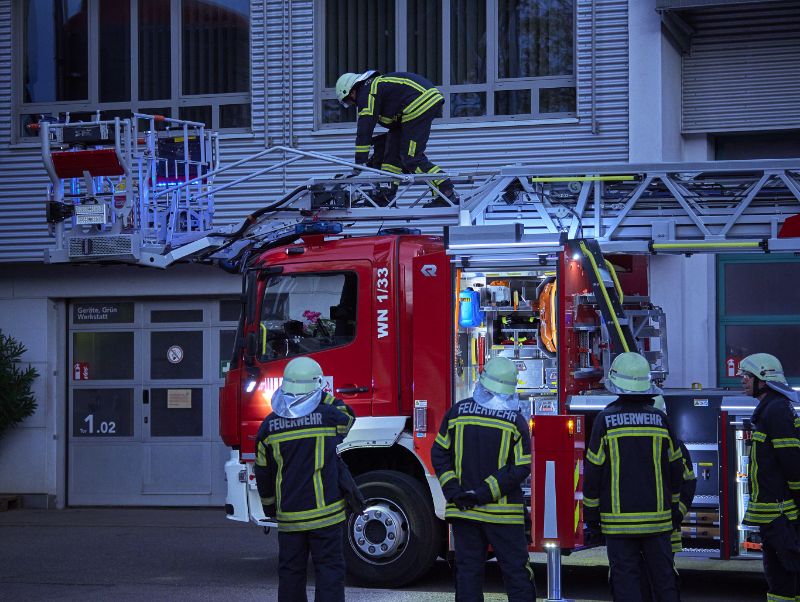
Training for FF Waiblingen volunteers includes how to use the new turntable ladder.
Michael Fuchs Deputy Head of Department of FF Waiblingen“Even being afraid of heights is not an obstacle to doing something in the fire service. We can accommodate everyone as long as they bring some fun and energy. Though we do require time and dedication. You have to really want to be a firefighter.”
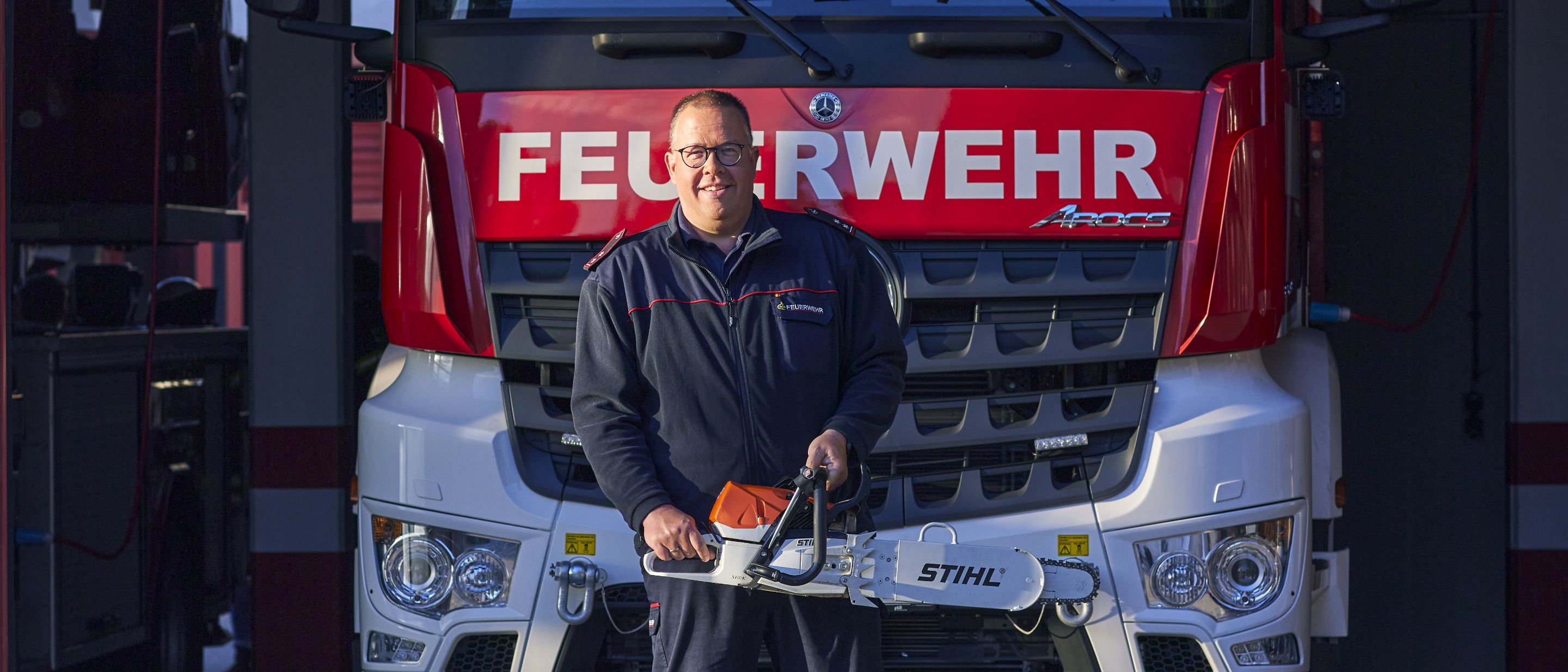
Michael Fuchs also works with products from his employer STIHL in the course of his volunteering as a firefighter.
Unpredictable and unstructured situations
“What means and possibilities do we have and how do we use them as effectively as possible?” As the Deputy Head of Department, Michael Fuchs is accustomed to taking responsibility – including in unpredictable and unstructured situations – and providing solutions that successfully guide his team through deployments. In fact this unpredictability and diversity is exactly what Michael Fuchs, a full-time project manager for chargers at STIHL, appreciates in his volunteer work. “We cover an incredibly wide spectrum of situations. When others can’t get any further, they always call the fire service.”
Always ready for action
Fortunately, funding is not a problem for FF Waiblingen. The municipalities are responsible for ensuring the fire brigade is adequately equipped. STIHL is also among the supporters of the local fire service. The mobile tool box or turntable ladder also carries several STIHL power tools, such as a pole pruner for removing broken branches from treetops. A cut-off saw, available in both gasoline and battery versions, along with an rescue chainsaw, warrant a spot in the rescue vehicle.
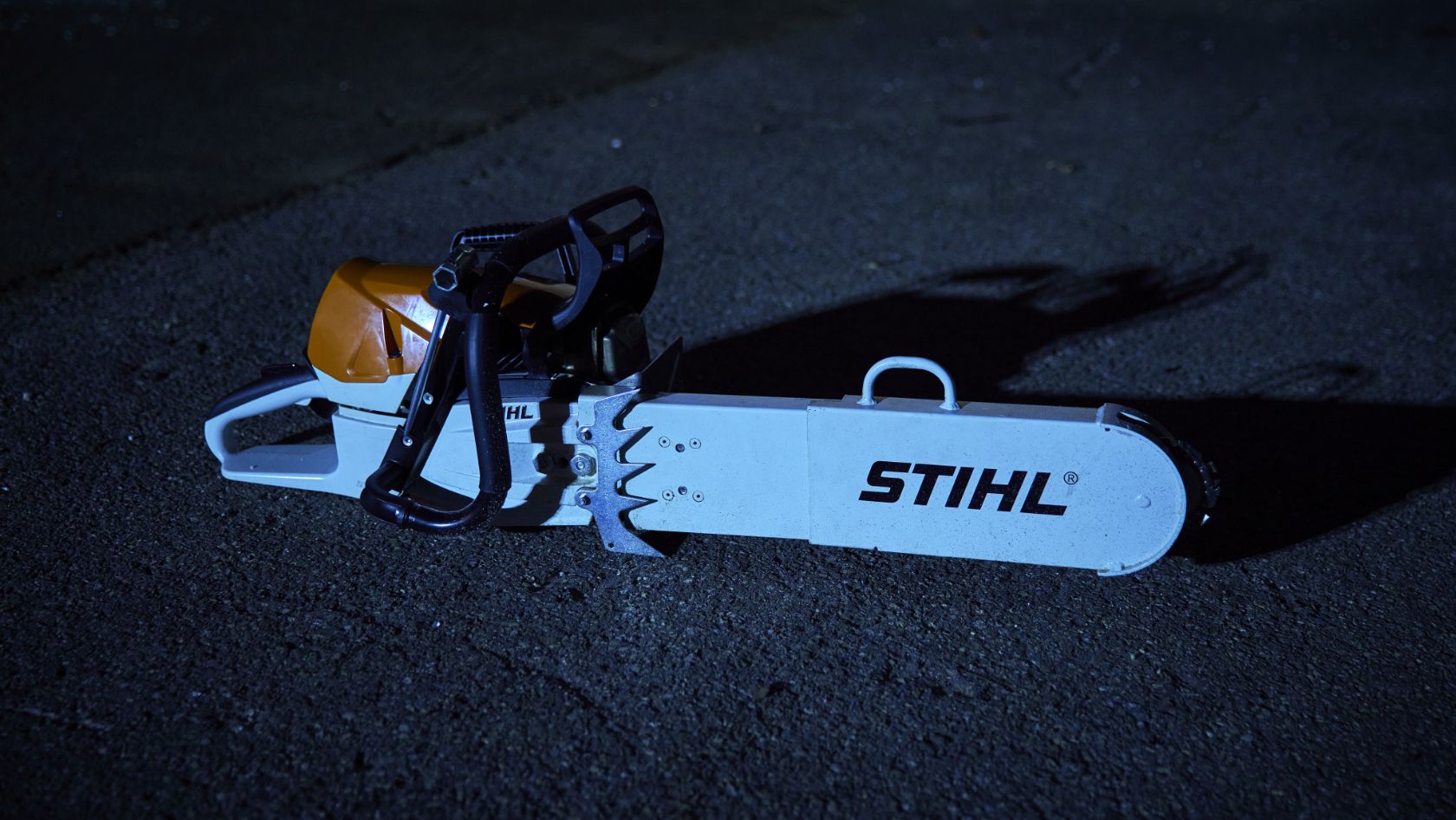
Today the STIHL rescue chainsaw (specifically the MS 462 RHD model) is an essential part of the equipment used by fire services and disaster relief organizations.
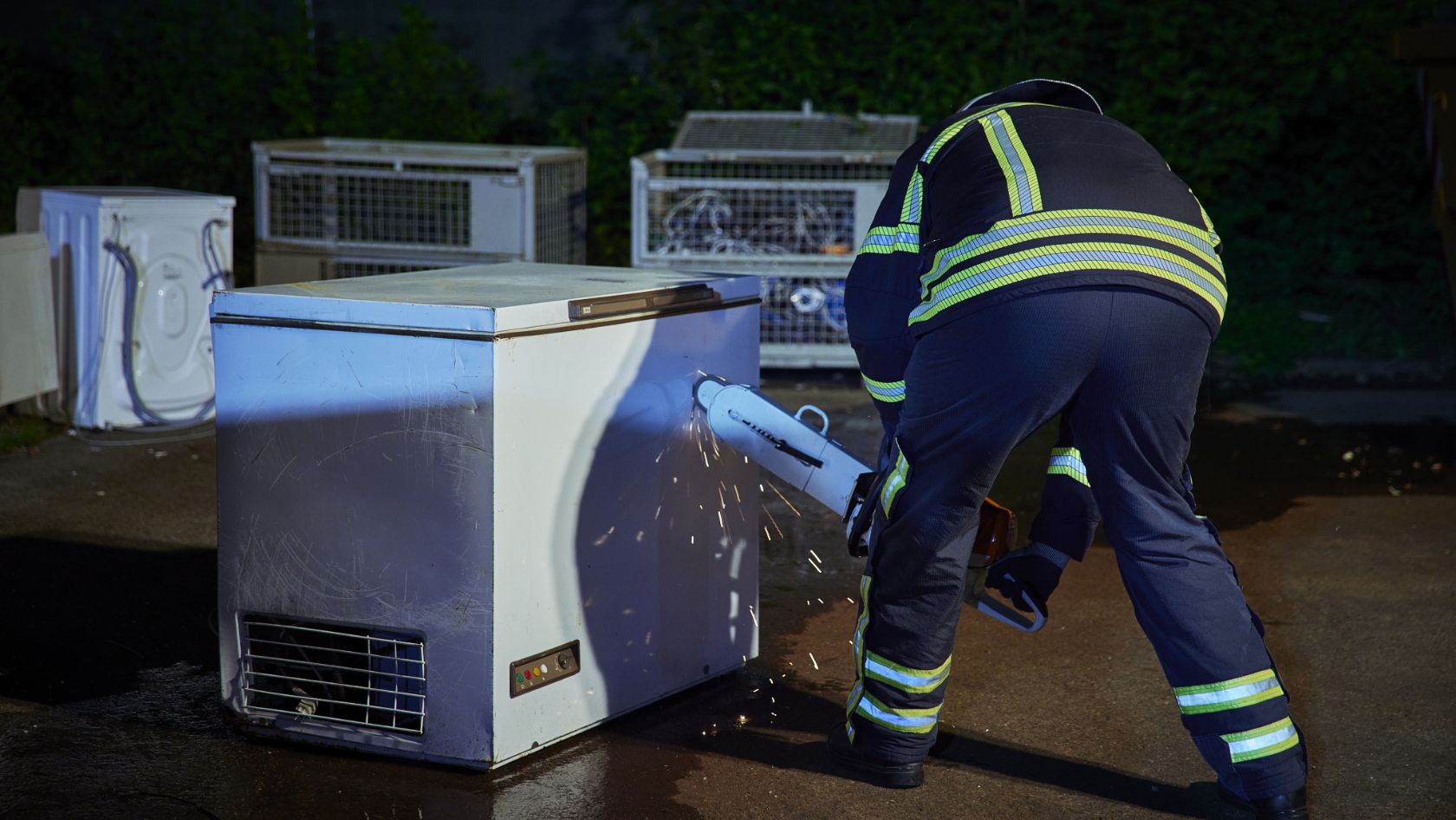
Handling of the rescue chainsaw is regularly tested at FF Waiblingen.
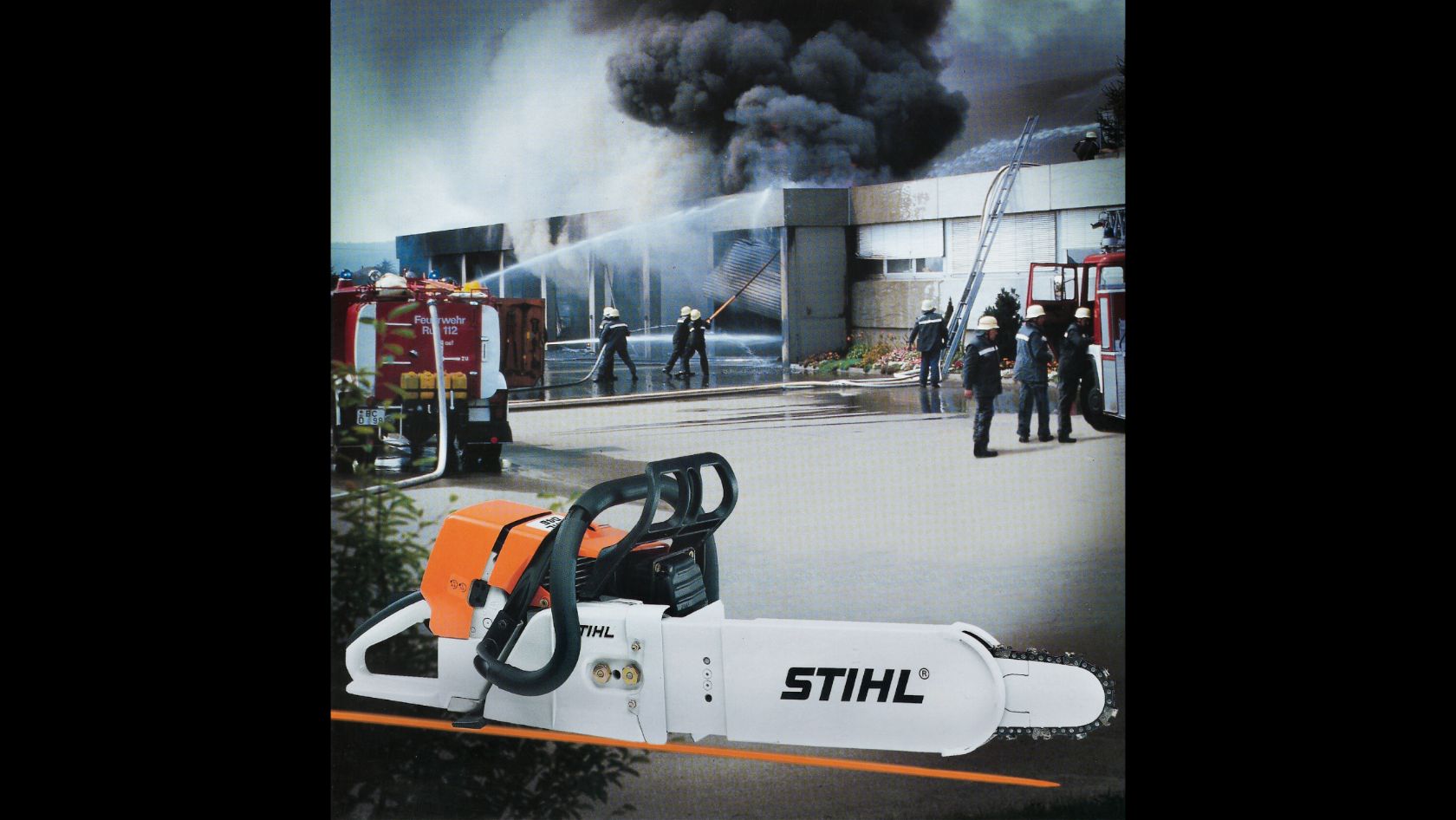
In 2000, the STIHL 046 RHD rescue chainsaw was still a new product, and it was promoted to the target group with all its advantages.
The rescue chainsaw
Specially developed for the needs of rescue organizations, these days it is a staple in the toolboxes of fire services, THW and disaster relief agencies. Development of the first STIHL rescue chainsaw was inspired by a devastating train accident in Eschede in 1998, in which 101 people died and 108 people were injured – most of them seriously. The accident is considered the most serious train accident in the history of the Federal Republic of Germany. Some 500 firefighters were deployed to the site, along with other operatives, but they did not have any tools which could effectively cut through window panes or the aluminum exterior walls of the intercity express train. The special saw was introduced to the market in 2000 with the model designation 046 RHD and – as the “Motorjournal” announced in its March issue of the same year – it was designed “for tough use.” The saw overcomes high cutting resistance. Equipped with a Rapid Duro Super carbide saw chain, which has cutting teeth reinforced with tungsten carbide and cobalt, it effortlessly cuts through a wide range of materials – including the solid glass windows of an intercity train.
A real wonder tool
The fire service volunteers are also testing the saw today. Michael Fuchs explains the most important considerations during use and demonstrates the impressive power of the saw on a discarded chest freezer – complete with flying sparks. The saw can of course also cut through much harder materials, such as copper and reinforced glass. However, for cost reasons – given that the saw chain is made from one of the hardest metal alloys – the saw is not pushed to its limits in practice situations. An important note: Only volunteers who have a chainsaw license are allowed to use this saw. Michael Fuchs explains that, although the saw in Waiblingen has not been used much, in the most challenging situations it is nonetheless a real miracle tool. For example, when the glass elevator at Waiblingen train station got stuck in scorching midday heat – only the rescue saw was able to cut through the glass and reach the people trapped inside. The saw’s depth limiter allows for precise adjustment of cutting depth, which ensured that no one on the other side would be injured.
incidents were handled by the Waiblingen fire station in 2024. The six departments of FF Waiblingen were deployed a total of 433 times during this period.
Testing for serious situations: On a construction site in Waiblingen, the firefighters are testing a new turntable ladder and lifting a multi-ton container using hydraulics and compressed air.
An understanding environment
The rescue chainsaw is an essential in the fire brigade’s toolbox. A special tool for special situations. However, the team and its equipment must be ready at all times of the day and night. “Because we have a lot of special equipment as a fire service support point, we are involved in most operations,” says Michael Fuchs. On average they are called out once a day in Waiblingen. This demands a high level of flexibility from him. “The law is clear: My employer must release me even during working hours. However, this should not cause any disadvantage either to me or my employer.” Sometimes he has to weigh up whether he can drop everything and go. STIHL still pays him for the full day in those cases, explains Michael Fuchs. “It is not obliged to do that, and I hugely appreciate my employer for it.” His friends and family are also very understanding about his “demanding hobby.” It is not possible without the agreement of family – that is something all fire service candidates need to keep in mind.
FF Waiblingen
More than 500 volunteers give their free time for the safety of others at the Waiblingen volunteer fire service. The service is divided into six departments, based on the locations of Waiblingen, Beinstein, Bittenfeld, Hegnach, Hohenacker and Neustadt. This “everywhere at all times” setup enables the fire service to arrive quickly wherever it is needed.
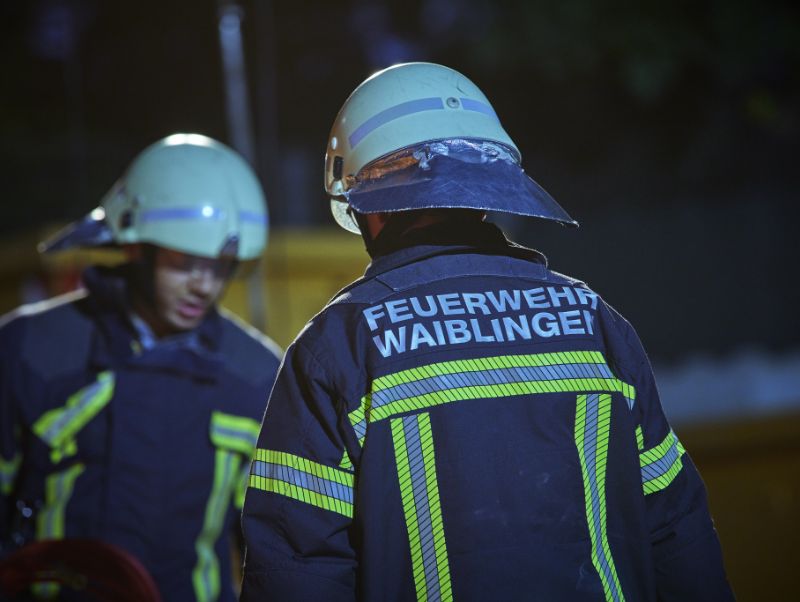
Michael Fuchs is one of more than 500 volunteers at FF Waiblingen.
Not a debating club
Emails, data evaluation, departmental meetings, preparation of statistics, planning overarching exercises – his volunteering work takes up ten hours a week on average, says Michael Fuchs. He also has to know: Is our fleet in good shape, and is everyone on the team fit? Who is available during the day and when? All of this needs to be organized in parallel, and Michael Fuchs expects the same level of commitment from everyone else at FF Waiblingen. Firefighting is a team sport. “In terms of what we do, this is not a debating club,” says Michael Fuchs. Which means follow-up is all the more important, as this is when decisions are explained and discussed. It is also where traumatic situations can be worked on. “You have to talk about these things from the soul. My wife knows that very well.”
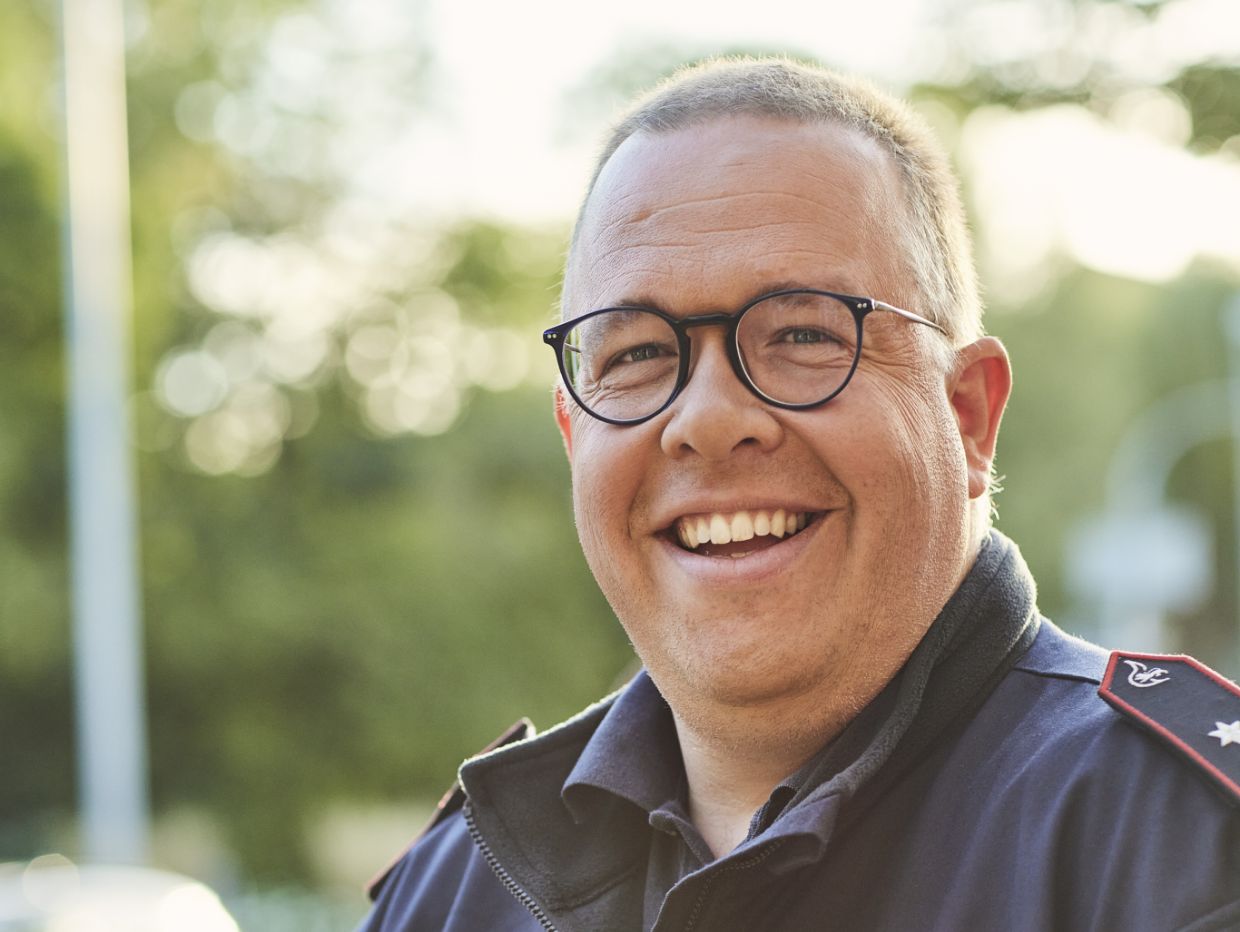
Has a time-consuming volunteer job: Michael Fuchs.
hours per year are, on average, spent by Michael Fuchs on his volunteer work – excluding deployments.
Totally solution-oriented
Michael Fuchs has been a firefighter for around 30 years. He couldn’t imagine a more meaningful hobby. Of course his affinity for technology is beneficial in missions too. His solution-oriented approach, honed through extensive experience in the fire service, also serves him well in his development work. After all, things don’t always go according to plan there either: “I rarely feel overwhelmed by that. I can always see a way to a good solution.”