
Generations in Dialog
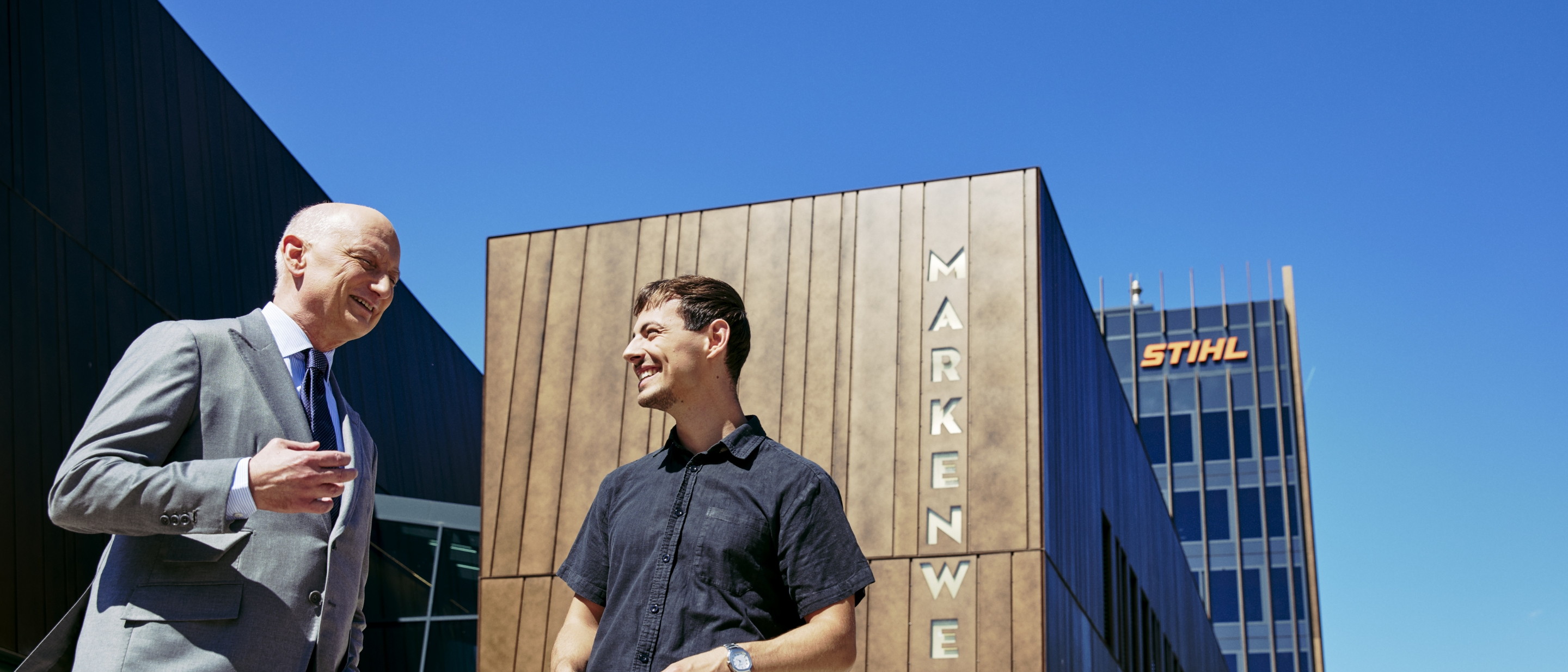
The STIHL Brand World in Waiblingen is the space that brings together the company's past, present, and future. It’s the ideal place for a unique conversation between two generations: Dr. Nikolas Stihl, Chairman of the Advisory Board and Supervisory Board at STIHL, meets with Tamino Soubawi, a youth and trainee representative bringing with him the questions of the newest generation at STIHL. To mark the anniversary, they look forward to the future together.
Strong Products
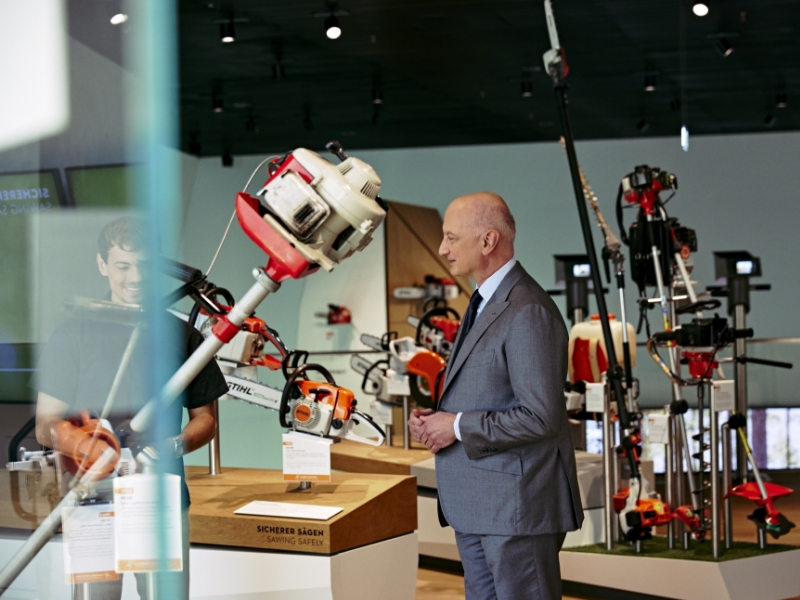
Since 1926, STIHL has stood for pioneering products that make it easier for people to work with and in nature. Digitalization and new technologies are transforming STIHL power tools, along with our service. Dr. Nikolas Stihl and Tamino Soubawi take a closer look at the product range in the “Vision and History” exhibition area of the STIHL Brand World. Surrounded by icons of the past, they discuss the strengths STIHL can count on in the future. Before long, their conversation flows so naturally that the prepared discussion guide is no longer needed. The conversation begins with a question that STIHL likes to ask during internal introductions: Which STIHL tool do you identify with?
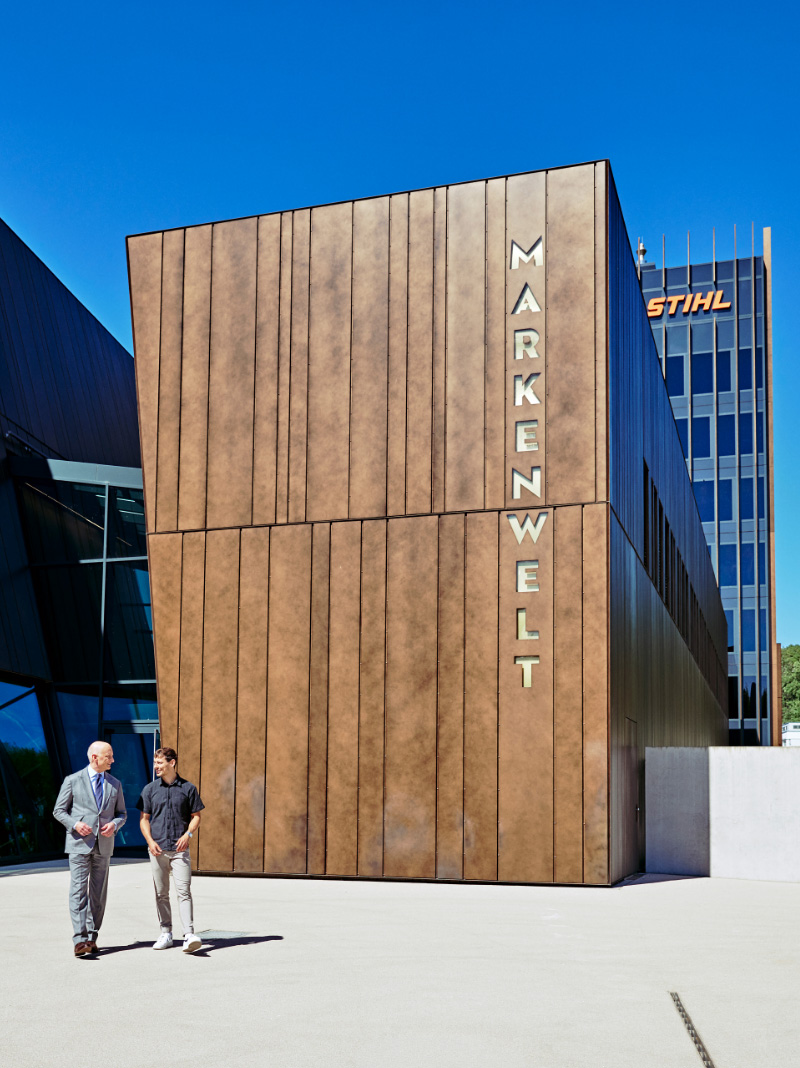
Dr. Nikolas Stihl (left) and youth representative Tamino Soubawi meet at the STIHL Brand World for a unique, first-of-its-kind conversation across generations.
Dr. Nikolas Stihl: “If I had to choose a STIHL product that fits me, it would be a Kombisystem, because I need to be versatile to handle any job like a Swiss army knife.”
Tamino Soubawi: “I would choose a chainsaw. It’s loud, shows real strength, and many like it. One of the most legendary chainsaws is, of course, the Contra. I’ve seen quite a few of them in use in the woods.”
Dr. Nikolas Stihl: “At the time, the Contra was unbeatable in terms of its performance. We also have the go-kart hanging next to the Contra to thank for that. Our work in racing in the early 1960s allowed us to build the Contra engine to withstand full throttle.”
Tamino Soubawi: “I am not surprised that the Contra has achieved cult status, because it embodies the quality and durability that STIHL stands for. Our customers know these products from their grandpa’s shed, and they recognize: This tool is 20, 30, or even 50 years old, and still works perfectly.”
Dr. Nikolas Stihl: “And it’s not just the Contra that can still be repaired today. That's the kind of sustainability that we really value.”
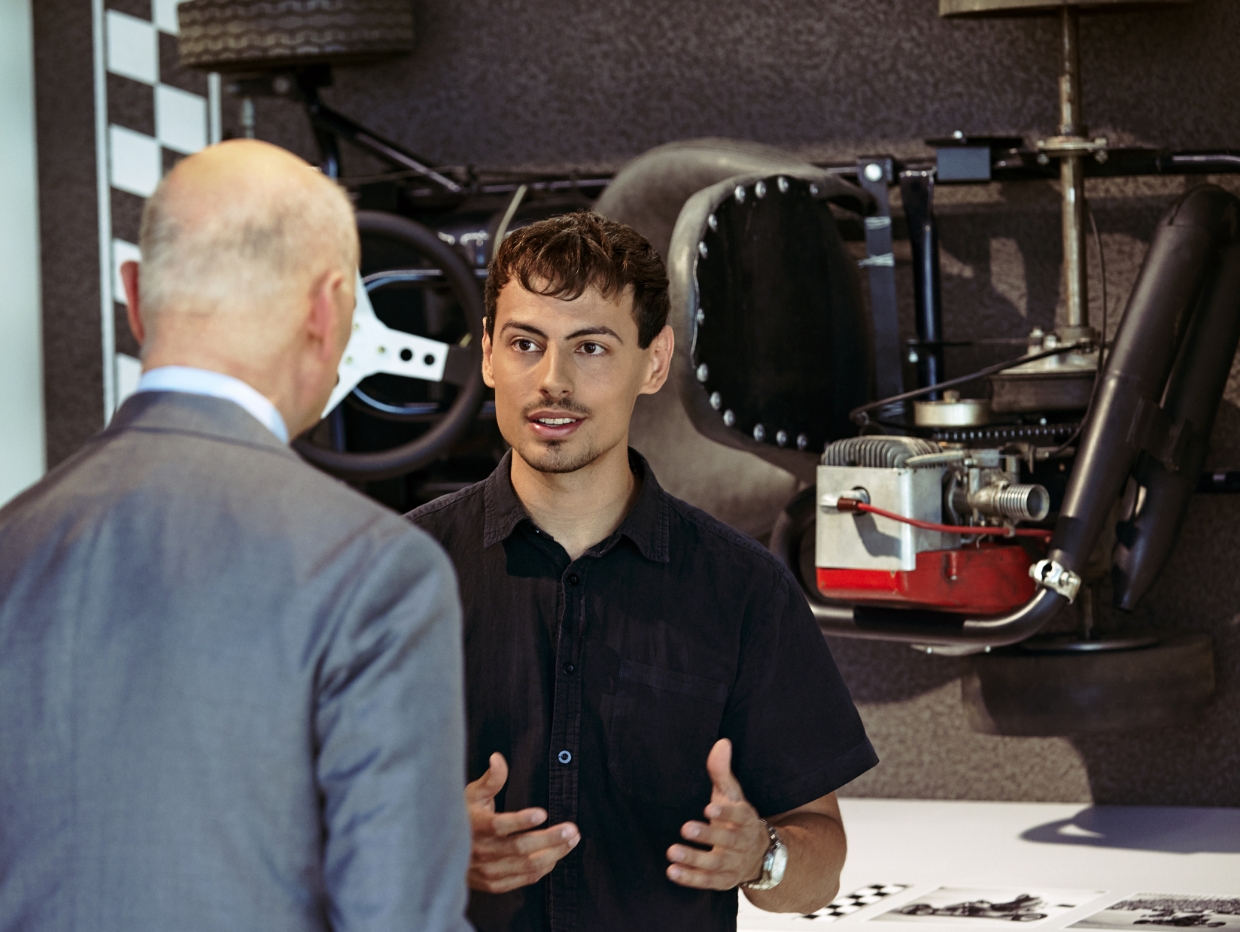
Tamino Soubawi and Dr. Nikolas Stihl surrounded by historic products like the Contra and the go-kart. During their conversation, they discuss: Innovation often takes place in several steps.
Tamino Soubawi: “Sustainability will become even more important in the future. Do you think our new battery-powered tools, with all their electronics, have the same potential to last just as long?”
Dr. Nikolas Stihl: “Definitely. We can already power older battery tool models with our latest batteries – and vice versa, use the batteries from the very first series in brand-new tools. We put a great deal of effort into this area because it is such an important aspect of sustainability. Battery technology is a good example of how we drive innovation: When we realized that batteries would soon be powerful enough to run our tools, we started developing battery packs and the matching tools early on. That was the biggest step. Since then, we have made continuous improvements – in small steps, from 1.5 kilowatts to 4 kilowatts of power today. By continuously refining innovations, you can really make significant progress.”

Dr. Nikolas Stihl's advice for young employees with creative ideas ...
Constant Change
The world has become fast-paced, and conditions can change overnight. How do we face change? How do we shape this? Change is part of STIHL’s DNA, as demonstrated by the many products displayed on the upper floor of the STIHL Brand World. Looking at the tractor hanging on the wall, their conversation turns to good and crazy ideas.
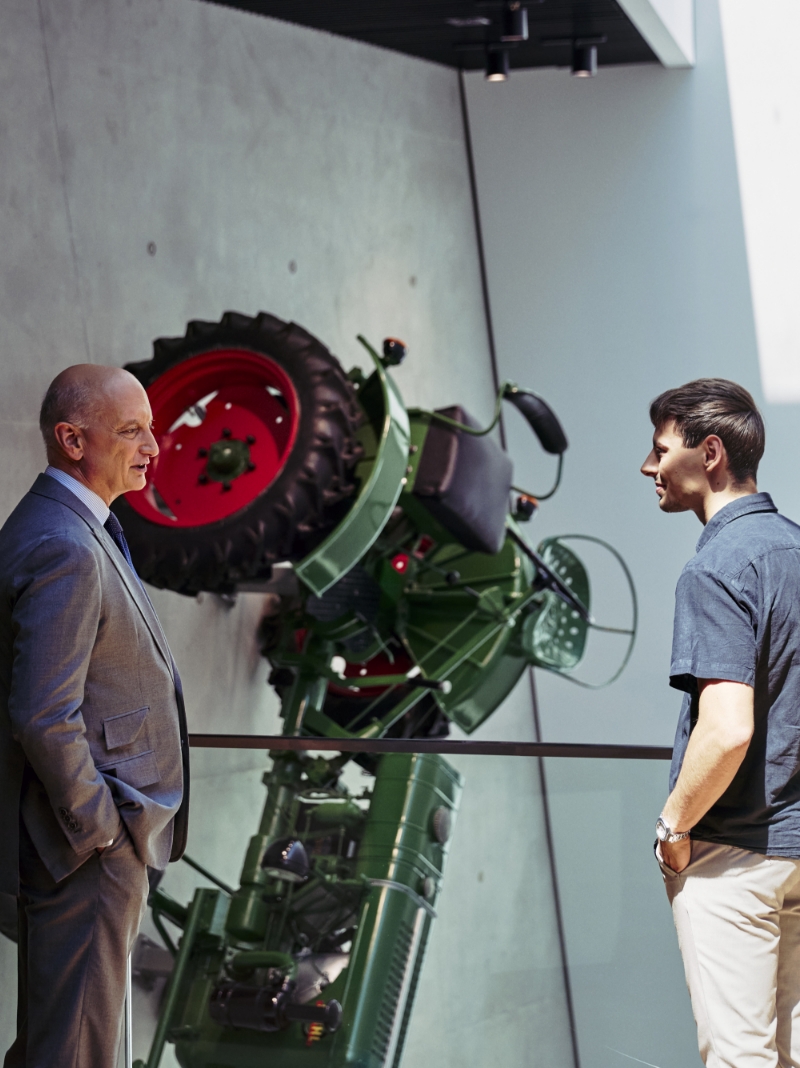
Some good ideas eventually become outdated – that's the lesson learned from our tractor production.
Tamino Soubawi: “Change is constant, and we have to keep up and evolve both in our own skills and products. And sometimes trees have to be pruned almost down to the trunk so they can sprout new growth. I have to think about that when I see the tractor on the wall here. Production was halted so STIHL could refocus completely on the chainsaw.”
Dr. Nikolas Stihl: “True. It is important to recognize exactly when something needs to be changed. For me, this is one of the most important capabilities you need to develop as a company: To look far enough into the future that you stay in control of change, rather than letting outside circumstances force your hand – because that’s when things usually get tough.”
Tamino Soubawi: “But that’s very difficult. After all, nobody really knows what's coming.”
Dr. Nikolas Stihl: “Yes, but you can go around the world with curiosity, look at things from different perspectives and combine them in new ways.”
Tamino Soubawi: “Those who are the most successful are usually the ones who have stumbled along the way. You might disprove your own theory and see that the approach was wrong. But you can also make new discoveries along the way.”
Dr. Nikolas Stihl: “And sometimes you have to let go of one idea to fully commit to another. That was also the case with our tractors: It was a good idea to build them. But when the competition built more powerful tractors, it made sense to focus on what STIHL can do best: chainsaws. If you can do something better than everyone else, that’s usually a good starting point for success.”
Tamino Soubawi: “Do you think we can continue to hold our position in the market in the future?”
Dr. Nikolas Stihl: “Well, in the near future, we will have to become more productive. There are new competitors with good products, and some of them are much cheaper because they manufacture in China. We need to offset this cost disadvantage by increasing productivity. We also need to find ways to make areas like IT or administration more productive than they are today. AI could also offer an opportunity there. I'm confident that we will succeed because we have the creativity and the drive to get things done. We can do certain things that others in the world can't. As you know, we are also a highly successful machinery manufacturer – whether it's building our own chain assembly lines or handling magnesium die casting. At the same time, I don't think our customer base is shifting so fast that we won't keep up.”

Why we need to throw around wild ideas more often – and what that has to do with the STIHL MS 500i …
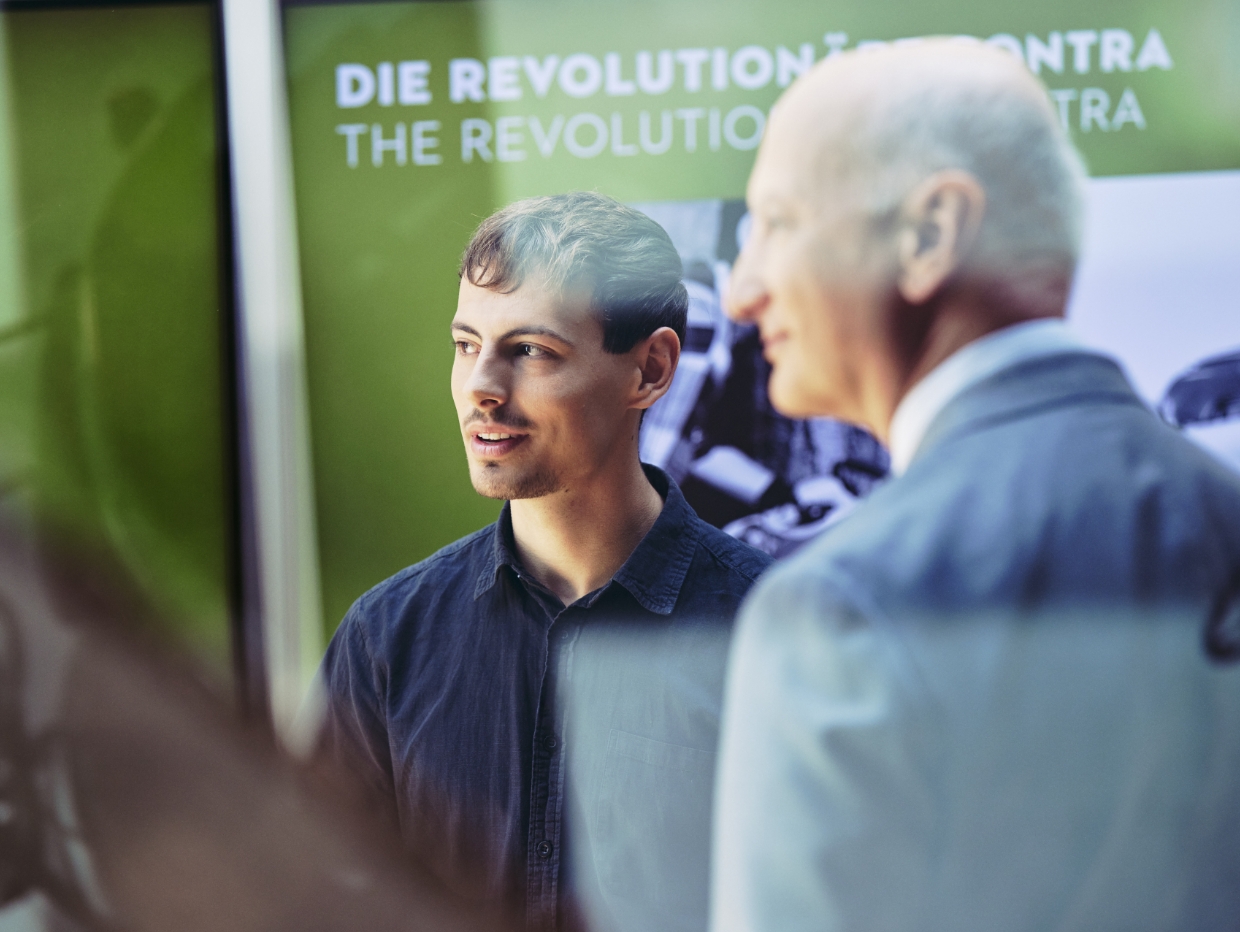
Both are curious about each other’s opinion: Dr. Nikolas Stihl and Tamino Soubawi in conversation.
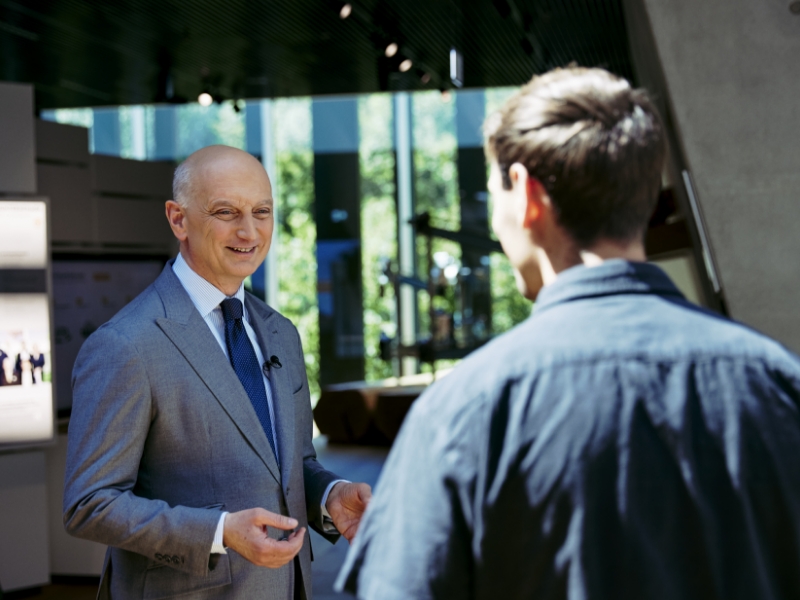
Working for the Future
Keep up the pace. The way we work has changed in recent years. And the job market is also changing. Which professions will still exist in the future, and in what form? Tamino Soubawi and Dr Nikolas Stihl take a deep look at the working world at STIHL. Both agree that its foundation – training – must remain attractive in the future.
Dr. Nikolas Stihl: “You work with us as an electrical engineer on our maintenance team. What does a typical work day look like for you?”
Tamino Soubawi: “We carry out regular maintenance and repairs on our equipment and also have to be on site at short notice if a machine fails. That’s why I need to adapt very flexibly to every situation, get up to speed on new issues fast, and know a wide variety of machinery. This is challenging, but also very interesting. I think electrical engineering will continue to be an exciting profession in the future. At the same time, many young people like me wonder which professions will stay relevant in the future, and which ones AI or automation will replace. What are your thoughts on this?”
Dr. Nikolas Stihl: “The answer might not please everyone: Every single profession requires us to adapt continuously. I hardly use anything from the studies I completed in the mid-1990s. We have to embrace lifelong learning – even more tomorrow than ever before. Learning how to learn is one of the most important tools you can carry with you from your training. And we as a company have a responsibility to make this possible.”

Why training for a practical career secures your future …
Tamino Soubawi: “If you were my age and starting your training here at our company, for example, what would you focus on today?”
Dr. Nikolas Stihl: “I think I would be very interested in mechatronics. I love mechanics, but I am also fascinated by the possibilities offered by electronics and electronic control. I find the combination of these very exciting. As a trained engineer, my enthusiasm for technology never left me.”
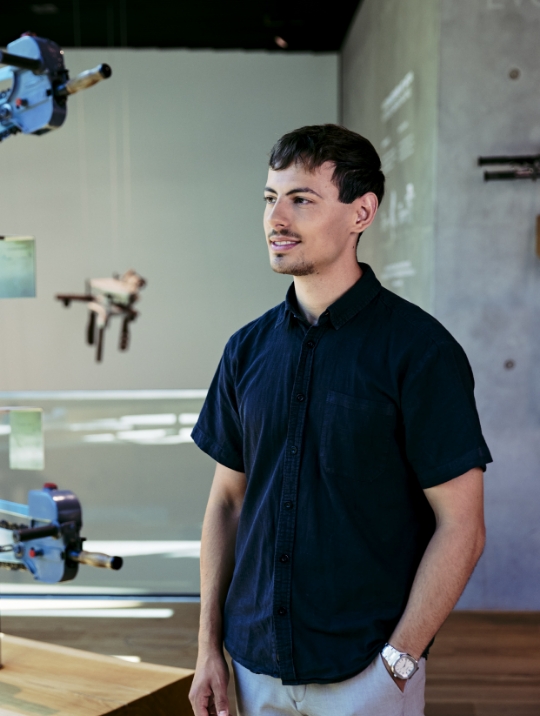
Tamino Soubawi Youth and trainee representative“Apprenticeships are an excellent foundation for a career. We have to get this message across to young people.”
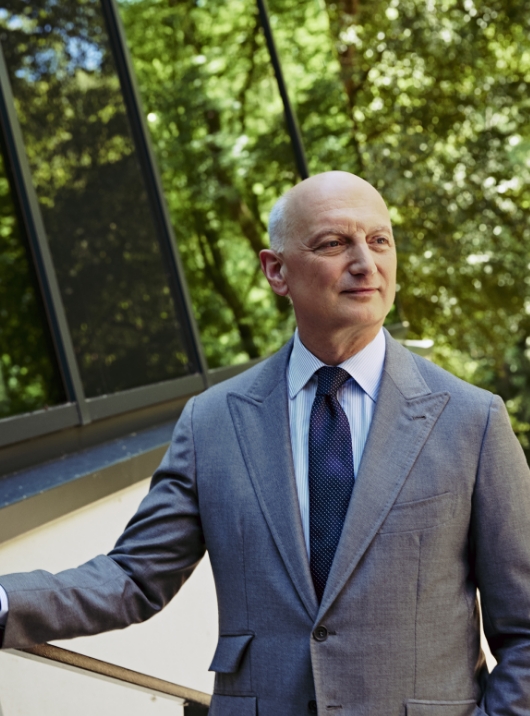
Dr. Nikolas Stihl Chairman of the Advisory Board and Supervisory Board“The prosperity in Germany is built on a variety of career paths – from apprenticeships to dual programs to university degrees.”
Shared Values and Mutual Respect
The passion for technology is shared by both generations. Both have a strong connection to STIHL as a family business – Dr. Nikolas Stihl from birth, Tamino Soubawi from experience. At the end of their tour, they find their shared values are deeply rooted in the corporate culture.
Dr. Nikolas Stihl: “What actually drew you to apply to work with us back then?”
Tamino Soubawi: “I had many acquaintances who spoke very positively about STIHL as an employer – also in terms of the fact that there is a family culture and you can feel welcome here. That was a deciding factor for me. And from my own experience, the family spirit is real: during my training, I got on well with everyone and I was able to communicate with everyone on equal terms. I have learned to really value that.”
Dr. Nikolas Stihl: “Do you still feel this way after your training?”
Tamino Soubawi: “Yes. When I walk through the plant, I see familiar faces everywhere and am greeted warmly. It really makes me feel at home here, and as a young employee, I feel valued. When I am called to fix a machine fault, my expertise as a maintenance technician is taken seriously.”
Dr. Nikolas Stihl: “This means that you are trusted and can fully apply what you have learned. This trust in the employees is very important.”
Tamino Soubawi: “Absolutely, that gives you confidence in your daily work. As an electrician, I didn't learn how to solve every single electrical problem. Instead, I was given the building blocks to think things through for myself and come up with solutions.”
Dr. Nikolas Stihl: “That’s exactly the right skillset. And that also includes creativity. I am glad to hear that you feel valued here. For me, it means that the values we represent as a family business are a lived reality in your daily work.”
Dr. Nikolas Stihl Chairman of the Advisory Board and Supervisory Board“Thank you for taking the time to talk with me. I always value the chance to talk with employees.”
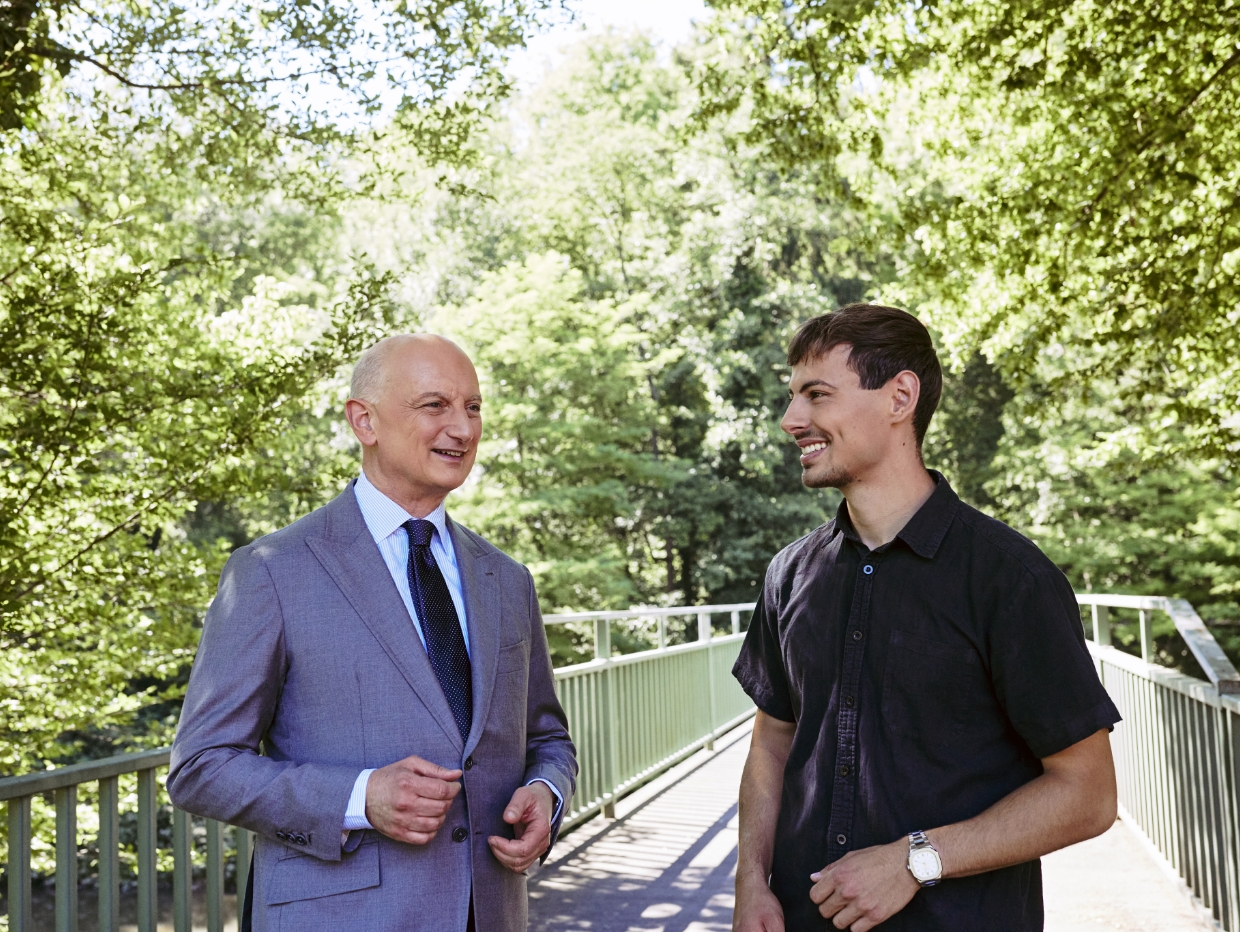
Even after visiting the STIHL Brand World, the conversation between the two generations keeps going.
Tamino Soubawi Youth and trainee representative“I really enjoyed it too. I believe that continuing this dialog is vital. And on behalf of all our young trainees, thank you.”